AI Image Generation: How It Actually Works and Why It Matters in 2026
Understand how AI image generation works under the hood. From diffusion models to transformers, learn the technology powering modern visual creation.
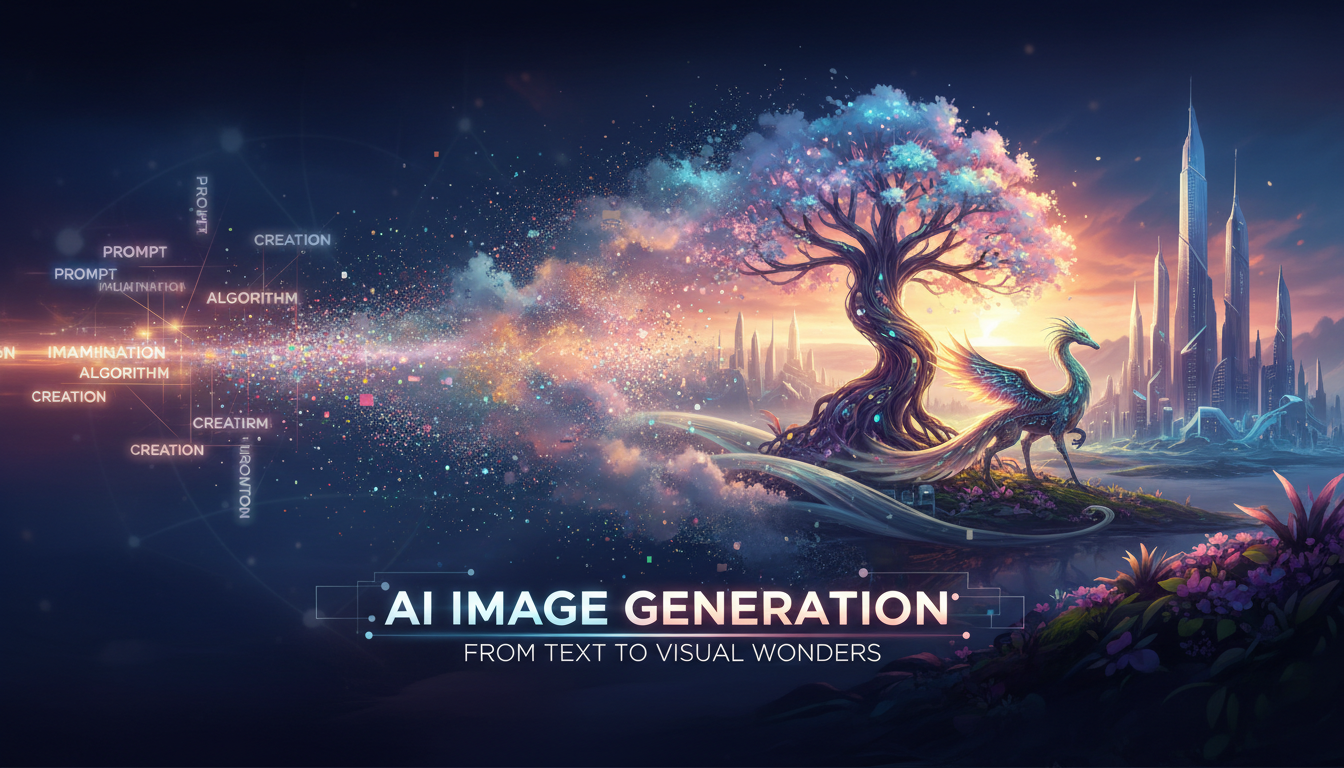
I remember the first time I watched an AI generate an image from a text prompt. It was mid-2022, using an early version of Stable Diffusion, and the output was a blurry mess of vaguely human-shaped colors. I thought, "well, that's a cool tech demo but nobody's going to use this for real work."
I was spectacularly wrong.
AI image generation has evolved from a parlor trick into the backbone of modern visual content creation. Professional designers use it daily. Marketing teams rely on it for campaigns. Independent creators build entire businesses around it. And the technology keeps improving at a pace that honestly makes it hard to keep up.
Quick Answer: AI image generation uses deep learning models (primarily diffusion models and transformers) to create images from text descriptions. The process involves training on millions of image-text pairs, then using that learned understanding to generate new, original images based on your prompts. Modern tools like Flux 2, Midjourney, and Stable Diffusion can produce photorealistic or artistic images in seconds.
- AI creates images through a process called "diffusion" where noise is gradually refined into coherent visuals
- Text prompts are converted into mathematical representations that guide the image creation process
- Modern models can generate photorealistic images, artistic illustrations, and everything in between
- Open-source tools have caught up to commercial offerings in quality
- Understanding how the technology works helps you write better prompts and get better results
What Is AI Image Generation, Really?
Let me cut through the marketing fluff and explain what's actually happening when you type a prompt and get an image back.
At its core, AI image generation is pattern recognition in reverse. The AI models have been trained on millions (sometimes billions) of image-text pairs. Through this training, they've learned incredibly detailed statistical relationships between words and visual concepts. They know that "sunset over ocean" involves warm colors at the top, water reflections, and a horizon line. They know that "golden retriever" involves specific fur textures, body proportions, and typical poses.
When you give it a prompt, the model doesn't search through a database of existing images. It constructs a new image from scratch, pixel by pixel, based on those learned relationships. Every generated image is technically original. It's never existed before.
Here's something that took me a while to internalize. These models don't "understand" what a dog looks like the way you or I do. They've learned statistical patterns that represent "dog-ness" in image space. The result looks like understanding from the outside, but the mechanism is fundamentally different from human perception.
How Does the Diffusion Process Work?
The dominant approach in 2026 is still diffusion-based models, though transformer architectures are making serious inroads. Let me walk you through both.
Diffusion Models: Starting with Noise
Imagine you have a perfect photograph. Now imagine adding static to it, like TV snow, one layer at a time. Eventually, the photo becomes pure random noise. A diffusion model learns to reverse this process.
During training, the model sees millions of images being gradually corrupted with noise. It learns to predict what each image looked like before the noise was added. It gets really, really good at this.
When you generate an image, the model starts with pure random noise and applies its de-noising skills step by step. But here's the clever part. Your text prompt guides the de-noising process. At each step, the model asks, "what would this noise look like if it were a little less noisy AND if it depicted 'a red bicycle leaning against a blue wall'?" Each step pushes the noise a little closer to a coherent image that matches your description.
This is why generation takes multiple "steps" (usually 20-50). Each step refines the image a little more. Too few steps and you get blurry, undefined results. Too many and you waste time without meaningful improvement. I've found that 25-30 steps is the sweet spot for most models, though newer architectures like Flux can get away with fewer.
Transformers: The New Challenger
Transformer-based approaches (used in DALL-E and increasingly in newer models) work differently. Instead of iterative noise removal, they predict image tokens sequentially, similar to how language models predict the next word in a sentence.
Think of it like building an image one small patch at a time, where each patch is influenced by your text prompt and all the patches that came before it. The advantage is that transformers can capture long-range dependencies (understanding that the left side of an image should be consistent with the right side) more naturally than diffusion models.
In practice, the outputs from both approaches look comparable. The architectural differences matter more for speed, training efficiency, and how well the model handles complex prompts. If you're just using these tools rather than building them, the distinction is mostly academic.
Why Does Understanding This Matter for Getting Better Results?
You might be thinking, "cool story about noise and transformers, but I just want to make good images." Fair enough. Here's why understanding the mechanism improves your practical results.
When you know that the model is de-noising guided by text embeddings, you understand why prompt specificity matters. Vague prompts give the model too much latitude. "A photo of a person" could de-noise into literally millions of different valid images. "A professional headshot of a middle-aged woman with short gray hair, wearing a navy blazer, soft studio lighting, shallow depth of field" constrains the de-noising process dramatically and gives you something much closer to what you actually want.
I wasted months writing prompts like I was talking to a human artist before I understood this. Now I think of prompts as constraints. Every descriptive word narrows the space of possible outputs. The more specific you are about what matters to you, the better your results.
This also explains why certain prompt structures work better than others. Leading with the subject, then adding descriptive details, then specifying style and technical qualities. You're essentially telling the model which constraints to prioritize.
If you want to dig deeper into prompt engineering, I covered practical techniques in my guide to getting started with AI image generation.
What Are the Main Types of AI-Powered Visual Creation?
The field has branched into several distinct capabilities, and understanding the differences helps you choose the right approach for your work.
Text-to-Image
This is what most people think of. You type a description and get an image. It's the most common use case and where the most development effort has been focused. Every major tool supports this, from Midjourney to Stable Diffusion to DALL-E.
The quality of text-to-image has improved dramatically. Two years ago, hands were always wrong, faces looked uncanny, and text in images was unreadable. Today, the leading models handle all of these capably (though not perfectly). For a thorough breakdown of tools, see my comparison of the best options available right now. If you want a deep dive into turning written descriptions into stunning visuals, my text to image AI guide covers the full process from prompt writing to final output.
Image-to-Image
You provide a source image and the model transforms it. This can mean style transfer (make this photo look like a watercolor painting), subject modification (change the person's outfit), or general enhancement. The model uses your source image as the starting point for de-noising instead of pure random noise.
I use img2img constantly for iterative refinement. Generate a base image with text-to-image, then use img2img to adjust specific elements. It's like sketching first and then refining, except the AI handles both stages.
Inpainting and Outpainting
Inpainting lets you modify specific regions of an existing image while keeping the rest unchanged. Select an area, describe what should replace it, and the model fills it in seamlessly. Outpainting extends images beyond their original boundaries, creating new content that matches the existing style and composition.
These capabilities transformed my workflow. Instead of regenerating entire images when one element is wrong, I can fix just the problematic area. It saves enormous amounts of time.
ControlNet and Guided Generation
This is where things get really interesting for professional work. ControlNet lets you provide structural guidance for generation. A pose skeleton, a depth map, an edge detection outline. The model follows this structure while creating the visual content.
For anyone doing consistent character work or product visualization, ControlNet is essential. I wrote a detailed guide on how ControlNet works if you want the deep dive.
What Tools Power This Technology Today?
The ecosystem has matured significantly. Here's how I categorize the landscape in 2026.
Cloud-Based Commercial Tools
Midjourney remains the aesthetic champion. The quality of its outputs, particularly for artistic and marketing visuals, is consistently impressive. The weakness is still the Discord-based interface and limited control over generation parameters.
DALL-E 3 (via ChatGPT) is the most accessible option. Natural language prompting, built-in safety, and seamless integration with the ChatGPT ecosystem. Quality is good but not class-leading.
Adobe Firefly focuses on commercial safety. Every output is explicitly licensed for commercial use, which matters for enterprise customers. Quality is improving but still behind Midjourney and Flux.
Open-Source Tools
Flux 2 has emerged as the overall quality leader, especially for prompt adherence and photorealism. It's open-source, meaning you can run it locally or through cloud platforms. The community has built an incredible ecosystem of LoRAs and extensions around it.
Stable Diffusion (SDXL and newer) remains the most flexible platform. Thousands of community models, an extensive ComfyUI node ecosystem, and complete control over every aspect of generation. The learning curve is steep, but the capabilities are unmatched.
If setting up a local environment feels daunting, platforms like Apatero let you access these models through a simpler interface. I use it for testing workflows before I commit to running them on my local hardware.
Specialized Tools
The interesting trend is the emergence of purpose-built tools. Character consistency generators, product photography AI, architectural visualization tools. These sacrifice generality for excellence in specific domains.
What Are the Practical Applications Right Now?
Let me share what I'm actually seeing people use this technology for, beyond the obvious "make cool pictures."
E-commerce product visualization. I know three small businesses that have completely replaced traditional product photography with AI generation. One of them told me their product image costs dropped from $50 per product to about $2. The quality is indistinguishable from real photos for catalog and website use.
Content creation at scale. Blog illustrations, social media graphics, ad creatives. A single creator can now produce visual content that would have required a design team. I generate all the hero images for this blog with AI, and honestly, the process takes less time than searching stock photo sites used to.
Rapid prototyping. Designers use text-to-image as a brainstorming tool. Instead of sketching 20 concepts, they generate 100 variations in minutes and narrow down from there. It doesn't replace design skill. It amplifies it.
Character and world building. Game developers, fiction writers, and tabletop RPG creators use these tools to visualize characters and environments. The consistency tools have gotten good enough that you can maintain a character's appearance across dozens of scenes.
Architecture and interior design. Generating photorealistic room designs from text descriptions. Clients can see proposed designs before any physical work begins. This one has legitimate business impact.
What Are the Limitations You Should Know About?
I'd be dishonest if I didn't acknowledge the real limitations that still exist.
Consistency across images. Generating the same character or scene from different angles is still challenging without specialized tools like LoRA training or IPAdapter. It's solvable, but requires technical knowledge that most casual users don't have.
Fine detail control. You can't easily say "move this element 2 inches to the left." The control is more abstract than precise. Tools like ControlNet help, but they add complexity.
Text rendering. It's gotten better, but still unreliable for anything beyond short phrases. If you need images with accurate text, you're still better off compositing text in post-production.
Ethical and legal uncertainty. The training data debate continues. Copyright questions remain unresolved. If you're using AI generation for commercial work, stay informed about the evolving legal landscape.
Speed for iteration. While a single image generates quickly, the process of generating, evaluating, adjusting prompts, and regenerating can still be time-consuming. Getting exactly what you envision might take dozens of attempts.
How Is Open Source Changing the Game?
Honestly, the open-source community has been the most exciting part of this space. The pace of innovation from independent researchers and community contributors rivals anything coming from well-funded labs.
Flux 2 is perhaps the best example. An open-source model that matches or exceeds commercial alternatives in multiple benchmarks. It happened because talented people could build on openly available research, iterate rapidly, and share improvements freely.
The ComfyUI ecosystem is another remarkable achievement. A node-based workflow tool that lets you chain together any combination of models, processors, and post-processing steps. The community has built custom nodes for everything from face swapping to style transfer to video generation. I covered some of the most useful ones in my ComfyUI custom nodes guide.
For anyone getting into this field seriously, I'd recommend starting with open-source tools. Not because they're free (though that helps), but because understanding the underlying mechanisms makes you better at using any tool, commercial or otherwise.
Full disclosure, I help build Apatero, which provides an accessible interface for open-source models. My bias toward open-source is both philosophical and practical. But even setting aside my involvement, the quality and flexibility of open-source options in 2026 is genuinely compelling.
What's Coming Next?
Making predictions in this space is embarrassing because the pace of change makes everything obsolete within months. But here are trends I'm confident about.
Real-time generation. We're already seeing sub-second generation times for lower resolution images. Within a year, I expect real-time generation at production quality to be standard. This changes the interaction model from "submit and wait" to "adjust and see."
3D and video convergence. The line between image, video, and 3D generation is blurring. Models that understand 3D space are emerging, meaning you'll be able to generate a scene and then "walk through" it with consistent perspective and lighting. This convergence is already visible in tools that let you animate photos with AI, turning still images into dynamic video clips with realistic motion.
Domain-specific excellence. Rather than general-purpose generators, expect tools that are exceptional at specific tasks. The best product photography AI, the best character design AI, the best architectural visualization AI.
Seamless editing workflows. Generation and editing are merging. Instead of generating a complete image and then editing it separately, you'll work interactively with the model, refining and adjusting in a continuous conversation.
Frequently Asked Questions
How do I start generating AI images?
The easiest starting point is DALL-E 3 through ChatGPT. Just describe what you want in plain English. For more control and better quality, explore Flux 2 through a hosted platform or set up Stable Diffusion locally. I put together a complete beginner's guide if you want step-by-step instructions. You can also check out my everything you need to know about AI pictures guide for a broader look at the field.
Is AI image generation free?
It can be. Running Stable Diffusion or Flux locally is free after hardware costs. Many commercial tools offer free tiers with limited monthly generations. For serious use, expect to spend $10-30/month on a subscription or cloud compute costs.
What's the difference between AI generation and AI editing?
Generation creates new images from text descriptions. Editing modifies existing images using AI. Many modern tools do both. Generation is better when you need something that doesn't exist yet. Editing is better when you have a starting point you want to modify.
Can AI generate images from other images?
Yes, this is called image-to-image (img2img) generation. You provide a source image and the AI transforms it based on your text prompt. This is useful for style transfer, modifications, and iterative refinement.
How long does it take to generate an AI image?
Typical generation times range from 2-15 seconds depending on the model, resolution, and hardware. Cloud services are usually faster than local hardware. Batch generation of multiple images can take longer but most platforms handle it efficiently.
Are AI-generated images detectable?
Current detection tools are unreliable, with accuracy rates varying widely depending on the model used and any post-processing applied. Some models leave statistical fingerprints, but as the technology improves, detection becomes increasingly difficult.
What resolution can AI generate?
Most models generate natively at 1024x1024 or 1280x768. Higher resolutions are achieved through upscaling techniques like SUPIR or SeedVR2. With proper upscaling, you can produce print-quality images at 4K and beyond.
Does AI steal from artists?
This is a legitimate and ongoing debate. Models are trained on large datasets of images from the internet, which includes copyrighted work. Whether this constitutes infringement is being tested in courts globally. The ethical dimensions go beyond legal questions. I'd encourage everyone using these tools to stay informed and make thoughtful choices.
What's the best model for photorealistic images?
Flux 2 currently leads for photorealism in my testing. For specific domains (product photography, portraits, architecture), fine-tuned Stable Diffusion models can be even more realistic because they're optimized for those specific use cases.
Can I use AI-generated images commercially?
Generally yes, with caveats. Commercial tools like Midjourney and DALL-E include commercial usage rights in their paid plans. Open-source models typically have permissive licenses. Always check the specific terms for your chosen platform and consult legal advice for high-stakes commercial use.
The Bottom Line
This technology has moved from novelty to necessity for visual content creation. The technology is accessible, the quality is impressive, and the tools keep getting better. For a comprehensive overview of every aspect of AI-powered visual creation, from generation to editing to enhancement, my ultimate guide to AI for images covers the full landscape. Whether you're a professional designer augmenting your workflow or a complete beginner exploring creative possibilities, there's never been a better time to start.
The key insight I wish someone had told me earlier is this. Don't try to learn everything at once. Pick one tool, learn it well, and expand from there. The fundamentals transfer across every platform. Good prompting, understanding of composition, and iterative refinement work everywhere.
And if the technology feels overwhelming, remember that two years ago, the people who are now experts in this field were exactly where you are today. The learning curve is real but manageable, and the creative payoff is enormous.
Make AI images and video in your browser
Characters, video, photo packs. No GPU, no setup. Check your welcome allowance and the displayed cost before generating.
Related Articles
5 Proven AI Influencer Niches That Actually Make Money in 2025
Discover the most profitable niches for AI influencers in 2025. Real data on monetization potential, audience engagement, and growth strategies for virtual content creators.
AI Background Replacement: Professional Guide 2025
Master AI background replacement for professional results. Learn rembg, BiRefNet, and ComfyUI workflows for smooth background removal and replacement.
AI Character Consistency: How to Maintain Virtual Persona Identity Across Content
Learn techniques for maintaining AI character consistency across hundreds of images. Master the art of creating recognizable virtual personas with consistent visual identity.