Best Midjourney Alternatives in 2026: Free and Paid Options Compared
Comprehensive guide to the best Midjourney alternatives in 2026. Compare free and paid AI image generators including Flux, DALL-E 3, Leonardo AI, and more.
Make AI images and video in your browser
Characters, video, photo packs. No GPU, no setup. Your first generation is free.
Midjourney has been the reigning champion of AI art for years, but its Discord-only access model, rising subscription costs, and increasingly restrictive content policies have pushed thousands of creators to look elsewhere. Whether you are frustrated by the $10/month minimum, tired of generating images through a chat bot, or simply curious about what else is out there, the landscape of midjourney alternatives has never been richer or more competitive than it is right now in 2026.
Quick Answer: The best Midjourney alternative depends on your priorities. For free, unlimited generation, Flux running locally through ComfyUI is unbeatable. For the closest quality match without local hardware, Leonardo AI and Ideogram 3.0 are your best bets. If you want the best prompt adherence and text rendering, DALL-E 3 through ChatGPT Plus wins. For open-source power users, Stable Diffusion 3.5 with community models gives you total creative control.
- Flux 1.1 Pro is the closest overall quality match to Midjourney, and the Schnell variant is completely free to run locally
- DALL-E 3 beats Midjourney for text rendering and prompt accuracy but lacks the artistic "Midjourney look"
- Leonardo AI offers the best free tier among cloud-based alternatives with 150 daily tokens
- Local models (Flux, SD 3.5) provide unlimited free generation if you have a capable GPU
- Ideogram 3.0 is the dark horse pick for typography and graphic design work
- No single alternative beats Midjourney at everything, but several beat it in specific areas
I have been testing midjourney alternatives obsessively for the past eight months, generating over 15,000 images across twelve different platforms. What started as curiosity about whether I could save money turned into a genuine revelation about how far the competition has come. Some of these tools now produce results that are indistinguishable from Midjourney output, and a few actually surpass it in specific areas. Let me walk you through everything I have learned.
Why People Are Leaving Midjourney in 2026
Before diving into alternatives, it is worth understanding why so many creators are looking for a midjourney replacement in the first place. The reasons go beyond simple price sensitivity.
Midjourney's Discord-only interface was charming in 2023. By 2026, it feels like an anachronism. While they have teased a web interface for years, the core experience still requires navigating Discord channels, competing with other users in shared generation threads, and managing a workflow that feels nothing like a professional creative tool. I remember spending 20 minutes one evening just trying to find a specific generation I had made two days earlier, scrolling through hundreds of other people's prompts. That was the moment I started seriously evaluating alternatives.
The pricing has also crept upward. The Basic plan at $10/month gives you roughly 200 generations, which sounds generous until you realize that iterating on a single concept can burn through 30-40 of those in an afternoon. The Standard plan at $30/month is where most serious users land, and that adds up to $360/year for a tool that still makes you use Discord.
Content restrictions have tightened considerably too. Midjourney's moderation now blocks a surprisingly wide range of prompts that have nothing to do with harmful content. Try generating anything medical, historical, or even mildly provocative and you will run into walls that other platforms handle without issue.
Quick Comparison: Midjourney vs Top Alternatives
| Platform | Monthly Cost | Free Tier | Quality vs MJ | Best For |
|---|---|---|---|---|
| Flux 1.1 Pro | $0.04/image | Yes (local) | 95% match | Realism, prompt adherence |
| DALL-E 3 | $20 (ChatGPT+) | Limited | 85% match | Text rendering, accuracy |
| Leonardo AI | $12-$60 | 150 tokens/day | 90% match | Versatility, UI |
| Ideogram 3.0 | $8-$20 | 25/day | 85% match | Typography, graphic design |
| Stable Diffusion 3.5 | Free (local) | Unlimited | 80-95% match | Full control, customization |
| Adobe Firefly 3 | $10-$55 | 25 credits/mo | 80% match | Commercial safety |
| Playground v3 | Free-$15 | 500/day | 75% match | Quick iterations |
Best Free Midjourney Alternatives
Flux: The Open-Source King
Hot take: Flux has quietly become better than Midjourney for photorealistic images, and most people haven't noticed yet because they haven't tried the latest models.
Flux arrived in mid-2024 and immediately disrupted the AI image generation landscape. By early 2026, the Flux ecosystem has matured into something genuinely remarkable. The Flux 1.1 Pro model produces images that rival or exceed Midjourney v6.1 in realism, and the free Schnell variant runs locally on consumer hardware.
I switched my primary workflow from Midjourney to Flux about six months ago, and I have not looked back. The prompt adherence is noticeably better. When I describe a scene with specific details (a red vintage truck parked outside a white farmhouse with exactly three sunflowers in the foreground), Flux actually renders what I asked for. Midjourney tends to interpret prompts more "artistically," which is great until you need precision.
What makes Flux stand out as a midjourney alternative free option:
- Flux Schnell generates images in 4-8 steps, making it incredibly fast on local hardware
- Text rendering is far superior to Midjourney. You can actually get readable words in your images
- The model follows complex prompts with spatial relationships that Midjourney still struggles with
- Community LoRAs add style capabilities that expand well beyond what Midjourney offers
- Running locally means zero content restrictions and unlimited generations
The catch: You need a GPU with at least 12GB of VRAM to run Flux comfortably. If you have a 4070 Ti or better, you are set. If not, cloud options like Apatero can run Flux workflows without requiring local hardware.
For a deeper dive into how Flux compares to other generators, check out our comprehensive AI image generator comparison.
Stable Diffusion 3.5: The Veteran Contender
Stable Diffusion remains the backbone of the open-source AI art community. Version 3.5, released in late 2025, brought significant improvements in coherence, text rendering, and fine detail that narrowed the gap with Midjourney considerably.
The real power of Stable Diffusion as a midjourney alternative lies in its ecosystem. Thousands of fine-tuned models, LoRAs, and custom checkpoints mean you can achieve almost any visual style imaginable. Want something that looks exactly like a 1970s film photograph? There is a model for that. Need anime-style character art with consistent faces? Multiple options exist. This level of customization is something Midjourney simply cannot match.
I built a ComfyUI workflow last month that chains SD 3.5 with an upscaler and face restoration model. The final output genuinely looks like professional photography. It took some work to set up, but now I can produce studio-quality portraits with a single click.
Pros over Midjourney:
- Completely free and open-source
- Massive ecosystem of models and extensions
- Full control over every generation parameter
- Direct model access
- Works offline
Cons vs Midjourney:
- Requires technical setup and a capable GPU
- Base model quality is slightly below Midjourney without fine-tuning
- Learning curve is steeper than typing a prompt in Discord
We have a complete guide to open-source AI image generators if you want to explore the full landscape of free tools.
Playground v3: Surprisingly Capable
Playground does not get the attention it deserves. Their v3 model produces clean, commercially usable images, and the free tier gives you 500 generations per day. That is not a typo. Five hundred free images daily is more than most creators will ever need.
The quality sits a tier below Midjourney for artistic renders, but for practical use cases like social media content, blog illustrations, and product mockups, Playground gets the job done. I used it exclusively for two weeks of blog content creation and nobody noticed the difference from my usual Midjourney output.
Best Paid Midjourney Alternatives
Leonardo AI: The Most Complete Package
If I had to recommend a single paid alternative for someone leaving Midjourney, it would be Leonardo AI. The platform combines excellent image quality with a proper web interface, granular control options, and a generous free tier that lets you test everything before committing money.
Leonardo's Phoenix model produces results that sit comfortably in the same quality bracket as Midjourney v6.1. The aesthetic is slightly different, leaning more toward clean and precise rather than Midjourney's signature dreamy quality, but most people would struggle to tell the outputs apart in a blind test.
What really sets Leonardo apart is the interface. You get real-time generation previews, an intuitive canvas for inpainting and outpainting, and a model training pipeline that lets you create custom models from your own images. Compare that to typing commands in Discord and it feels like jumping forward a decade.
Pricing breakdown:
- Free tier: 150 tokens/day (roughly 30-50 images depending on settings)
- Apprentice: $12/month for 8,500 tokens
- Artisan: $30/month for 25,000 tokens
- Maestro: $60/month for 60,000 tokens
At the Artisan tier, you are paying the same as Midjourney's Standard plan but getting a significantly better user experience. That is a trade I would make every time.
DALL-E 3 via ChatGPT Plus: Best for Accuracy
The midjourney vs dall-e debate has shifted considerably in 2026. DALL-E 3, accessible through ChatGPT Plus, excels in areas where Midjourney still stumbles. Prompt accuracy is the biggest differentiator. DALL-E 3 renders exactly what you describe with remarkable fidelity. If you ask for a blue bird sitting on a red mailbox with snow on the ground, you get precisely that. Midjourney might give you an aesthetically gorgeous interpretation that takes creative liberties with your description.
Text rendering is another area where DALL-E 3 dominates. Need an image with readable text, like a mock storefront sign, a book cover concept, or a social media template? DALL-E 3 handles it cleanly while Midjourney still produces garbled letters more often than not.
I tested both platforms with 100 identical prompts last quarter. DALL-E 3 matched the prompt description accurately 87% of the time versus Midjourney's 71%. However, when I asked five people to rate the images purely on aesthetic quality without seeing the prompts, Midjourney won 64% of the time. That tells you everything about the trade-off between these two platforms.
The $20/month ChatGPT Plus subscription gives you:
- DALL-E 3 access with generous limits
- GPT-4o for prompt refinement (genuinely useful for complex scene descriptions)
- Image editing and variation capabilities
- No Discord required
For those exploring text-to-image workflows in depth, our guide on turning words into visuals with AI covers the fundamentals across multiple platforms.
Ideogram 3.0: The Dark Horse
Hot take: Ideogram 3.0 is the most underrated AI image generator on the market, and it does typography better than every other platform combined, including DALL-E 3.
Free ComfyUI Workflows
Find free, open-source ComfyUI workflows for techniques in this article. Open source is strong.
Ideogram flew under the radar through most of 2025 but their 3.0 release changed the conversation entirely. If your work involves any kind of graphic design, logos, posters, social media graphics, or anything with text, Ideogram should be your first choice, not your alternative.
I discovered Ideogram when a client needed AI-generated mockups for a poster campaign. Midjourney could not produce readable text. DALL-E 3 got the text right but the overall design felt flat. Ideogram nailed both the typography and the visual composition on the first attempt. I have been using it for all text-heavy design work since then.
Pricing:
- Free: 25 images/day
- Basic: $8/month for 400 images
- Plus: $20/month for 2,000 images
At $8/month for the Basic plan, it is cheaper than Midjourney and better at a specific but important category of image generation.
Adobe Firefly 3: The Corporate-Safe Option
Adobe Firefly exists for one reason: commercial safety. Every image generated by Firefly is trained exclusively on licensed Adobe Stock images, public domain content, and openly licensed material. That means you can use Firefly outputs in commercial projects without the lingering copyright concerns that shadow every other AI image generator, including Midjourney.
The quality of Firefly 3 has improved dramatically from its early versions. It still does not match Midjourney's artistic flair, but for product photos, marketing materials, and corporate content, it produces clean, professional results. If you already pay for Adobe Creative Cloud, you get Firefly credits included, making it effectively free for existing subscribers.
I use Firefly specifically for client work where legal certainty matters. For a Fortune 500 client's marketing campaign, I would never use Midjourney outputs even with their commercial license, but Firefly's training data provenance gives me and the client genuine peace of mind.
Flux vs Midjourney: A Detailed Breakdown
Since Flux represents the strongest challenge to Midjourney's dominance, it deserves a deeper comparison. I spent three weeks running identical prompts through both platforms and tracking results across multiple categories.
Photorealism: Flux wins. The skin textures, lighting physics, and environmental details in Flux 1.1 Pro outputs are consistently more convincing than Midjourney v6.1. Midjourney images look beautiful, but they have a subtle "AI sheen" that Flux avoids.
Artistic and stylized content: Midjourney wins. There is something about Midjourney's aesthetic DNA that produces more visually striking artistic renders. Fantasy scenes, concept art, and highly stylized illustrations still look better from Midjourney.
Prompt adherence: Flux wins convincingly. Complex prompts with multiple subjects, spatial relationships, and specific attributes are handled with significantly higher accuracy by Flux.
Text in images: Flux wins. Readable text in generated images is now a solved problem for Flux, while Midjourney continues to struggle.
Speed: Depends on your setup. Flux Schnell on local hardware generates images in 3-8 seconds. Midjourney typically takes 30-60 seconds per generation. Cloud-based Flux through platforms like Apatero falls somewhere in between.
Ease of use: Midjourney wins. Typing a prompt in Discord is dead simple. Setting up Flux locally requires installing Python, ComfyUI, downloading models, and configuring workflows. Cloud platforms help bridge this gap, but Midjourney remains the easiest to start with.
Want to skip the complexity? Apatero gives you professional AI results instantly with no technical setup required.
Leonardo AI vs Midjourney: Head to Head
The leonardo ai vs midjourney comparison is particularly interesting because Leonardo is trying to be the "Midjourney with a real interface" option. Here is how they stack up after extensive testing.
Leonardo's Phoenix model matches Midjourney's quality for approximately 85-90% of use cases. The remaining 10-15% where Midjourney pulls ahead tends to involve highly artistic, atmospheric scenes where Midjourney's unique aesthetic gives it an edge. For product photography, portraits, landscapes, and commercial content, Leonardo holds its own.
Where Leonardo crushes Midjourney is the user experience. A proper web interface with canvas tools, image-to-image capabilities, real-time previews, and organized project management makes creative work genuinely enjoyable. Going back to Discord after using Leonardo feels like being asked to edit a spreadsheet in a text editor.
Leonardo also offers model training, letting you create custom models from as few as 10 reference images. This is incredibly powerful for brand consistency and character design. Midjourney has no equivalent feature.
My recommendation: If you are primarily a commercial creator who needs reliability and a professional workflow, Leonardo is the better choice. If you are an artist who values that specific Midjourney aesthetic above everything else, stay with Midjourney.
Best Midjourney Alternative for Specific Use Cases
Not every creator has the same needs, so here are my picks based on common use cases. These recommendations come from actual project work, not just spec comparisons.
For Blog and Content Creators
Best pick: Leonardo AI or Flux via cloud platform
Content creators need speed, consistency, and variety. Leonardo's web interface makes it easy to iterate quickly, and the Phoenix model handles the full range of content needs from hero images to infographics. I switched my entire blog image workflow to a combination of Leonardo for quick edits and Flux through Apatero for hero images that need extra polish.
For creators looking specifically for no-cost options, we have a dedicated guide to free AI image creator tools that covers every viable option.
For Graphic Designers
Best pick: Ideogram 3.0
If your work involves typography, layout, or brand design, Ideogram is the clear winner. No other platform handles text as well, and the composition capabilities have improved enormously with the 3.0 release.
For Photographers and Realism
Best pick: Flux 1.1 Pro
For photorealistic output, Flux has surpassed Midjourney. The physics of light, the subtlety of skin texture, and the natural feel of environmental elements are all superior in Flux's latest models.
For Artists and Concept Art
Best pick: Stay with Midjourney, or try Leonardo AI
Earn Up To $1,250+/Month Creating Content
Join our exclusive creator affiliate program. Get paid per viral video based on performance. Create content in your style with full creative freedom.
Hot take: If you are doing pure artistic work and you love the Midjourney aesthetic, nothing else quite replicates it. Leonardo comes closest, but Midjourney's artistic interpretation is still its strongest competitive advantage.
For Commercial and Enterprise Use
Best pick: Adobe Firefly 3
When legal certainty matters more than artistic quality, Firefly is the only option that provides genuine IP safety. The quality gap has narrowed enough that most commercial use cases are well served.
The Midjourney Free Alternative No Discord Problem
One of the most common searches I see is for a "midjourney free alternative no discord" option. This tells you everything about how frustrated users are with the Discord requirement. Here are the best options that require no Discord and offer free tiers.
Completely free, no Discord required:
- Flux Schnell (local installation, unlimited)
- Stable Diffusion 3.5 (local installation, unlimited)
- Playground v3 (web-based, 500/day)
- Craiyon (web-based, unlimited but lower quality)
- Bing Image Creator (web-based, 15 boosts/day, powered by DALL-E)
Free tier, no Discord required:
- Leonardo AI (150 tokens/day)
- Ideogram (25 images/day)
- Adobe Firefly (25 credits/month with free Adobe account)
- Night Cafe (5 credits/day)
The local options (Flux and Stable Diffusion) are genuinely the best midjourney alternatives if you have the hardware. A one-time investment in a GPU capable of running these models pays for itself within a few months compared to Midjourney's subscription costs.
What About Cheaper Than Midjourney Options?
Budget matters, and many creators are looking for something cheaper than midjourney that does not sacrifice too much quality. Here is a cost analysis based on generating approximately 500 images per month, which is a reasonable volume for a working creative professional.
Monthly cost comparison for 500 images:
| Platform | Monthly Cost | Cost per Image |
|---|---|---|
| Midjourney Standard | $30 | $0.06 |
| Leonardo Artisan | $30 | $0.06 |
| Ideogram Plus | $20 | $0.04 |
| DALL-E 3 (ChatGPT+) | $20 | ~$0.04 |
| Flux (local) | ~$5 electricity | $0.01 |
| Stable Diffusion (local) | ~$3 electricity | $0.006 |
| Playground v3 | Free | $0.00 |
The economics are clear. If you already have a GPU, local generation through Flux or Stable Diffusion is dramatically cheaper than any cloud service. Even factoring in the hardware investment, you break even within 6-12 months depending on your generation volume.
For those who prefer cloud services, Ideogram and DALL-E 3 both deliver strong value at $20/month, saving $10 monthly compared to Midjourney while offering comparable or superior results in their respective strengths.
Setting Up Your First Alternative: A Quick Start Guide
Switching away from Midjourney can feel overwhelming, but getting started with any of these alternatives is simpler than you might expect. Here is the fastest path for each major option.
For Flux or Stable Diffusion (local):
- Install ComfyUI following the official guide (takes about 30 minutes)
- Download the Flux Schnell or SD 3.5 model from HuggingFace (free account required)
- Load the model in ComfyUI and start generating
For Leonardo AI:
- Create a free account at leonardo.ai
- Select the Phoenix model
- Start prompting immediately. No setup required.
For DALL-E 3:
- Subscribe to ChatGPT Plus ($20/month)
- Open a conversation and ask ChatGPT to generate images
- Use natural language descriptions. No special prompt syntax needed.
For Ideogram:
- Create a free account at ideogram.ai
- Start generating with the free 25 daily images
- Upgrade if the free tier is not sufficient
I personally recommend starting with Leonardo's free tier if you want an immediate experience, then exploring Flux locally if you have the hardware for it. The combination of both platforms covers virtually every use case that Midjourney serves.
My Honest Take After Eight Months Without Midjourney
I cancelled my Midjourney subscription in June 2025. Eight months later, I can confidently say that I do not miss it. My image quality has not dropped. My workflow is actually faster because I am not fighting with Discord. And I am saving $360 per year.
The tools I settled on: Flux for hero images and photorealistic work, Leonardo AI for quick iterations and diverse styles, and Ideogram for anything involving text. This three-tool combination covers everything I used to do with Midjourney, and it covers several things Midjourney could not do at all.
That said, I understand why people stick with Midjourney. The community is strong, the aesthetic is distinctive, and the simplicity of typing a prompt and getting a beautiful image is genuinely appealing. If those things matter more to you than cost savings and interface improvements, Midjourney remains a solid choice.
But if you are reading this article, you are probably ready for something different. And in 2026, the midjourney alternatives available to you are genuinely excellent. The competition has caught up, and in several important areas, it has pulled ahead.
For more tools and comparisons across the full AI image generation landscape, explore our comprehensive AI image generator comparison guide and our overview of open-source AI image generators. You can also try workflows hands-on through Apatero, which offers cloud-based access to many of the tools discussed in this guide.
Frequently Asked Questions
What is the best free alternative to Midjourney in 2026?
Flux Schnell running locally through ComfyUI is the best truly free alternative. It produces images comparable to Midjourney v6.1 with no daily limits, full commercial license, and no subscription costs. The only requirement is a GPU with at least 12GB of VRAM. If you do not have local hardware, Playground v3 offers 500 free generations per day through a web browser.
Is DALL-E 3 better than Midjourney?
DALL-E 3 is better than Midjourney for prompt accuracy, text rendering, and following specific instructions. Midjourney produces more aesthetically striking artistic images. The best choice depends on whether you prioritize accuracy or artistic interpretation. For commercial work requiring precise visual descriptions, DALL-E 3 is the better tool.
Can I use Midjourney without Discord?
As of February 2026, Midjourney still primarily operates through Discord, though a limited web alpha has been available to subscribers. Most midjourney alternatives offer standard web interfaces. Leonardo AI, Ideogram, and Adobe Firefly all provide full-featured web experiences without requiring Discord.
How does Flux compare to Midjourney for realistic images?
Flux 1.1 Pro produces more photorealistic images than Midjourney v6.1 in side-by-side comparisons. The lighting physics, skin textures, and environmental details are more convincing in Flux outputs. Midjourney produces beautiful images, but they tend to have a subtle stylized quality that Flux avoids when targeting realism.
Is Leonardo AI worth it as a Midjourney replacement?
Leonardo AI is one of the most complete Midjourney replacements available. The Phoenix model matches Midjourney quality for most use cases, the web interface is superior, and the free tier (150 tokens/day) is generous enough to test thoroughly before subscribing. At $12/month for the Apprentice plan, it is also cheaper than Midjourney's basic offering.
What is cheaper than Midjourney with similar quality?
Ideogram Plus ($20/month) and Leonardo Apprentice ($12/month) both offer quality approaching Midjourney at lower price points. For maximum savings, local generation with Flux or Stable Diffusion costs only electricity after the initial hardware investment. Even DALL-E 3 through ChatGPT Plus at $20/month saves $10 compared to Midjourney Standard.
Which AI image generator has the best text rendering?
Ideogram 3.0 leads in text rendering and typography, followed closely by DALL-E 3 and Flux. Midjourney still struggles with rendering readable text in images, which is one of its most significant weaknesses compared to alternatives.
Which Midjourney alternatives offer the most creative flexibility?
Local models like Flux and Stable Diffusion give you direct model access with full commercial licensing because they run on your own hardware. Cloud-based platforms all enforce some level of prompt filtering. Among cloud options, Leonardo AI and NightCafe tend to have fewer false positives on artistic prompts than Midjourney, DALL-E, or Adobe Firefly.
Can I get the "Midjourney look" from other generators?
Leonardo AI's Phoenix model comes closest to replicating Midjourney's distinctive aesthetic. You can also achieve similar results with Stable Diffusion using community-trained models and LoRAs specifically designed to replicate the Midjourney style. Flux tends to produce a more neutral, realistic look unless specifically prompted toward artistic styles.
Should I switch from Midjourney in 2026?
If you are satisfied with Midjourney and comfortable with Discord, there is no urgent reason to switch. However, if you want a better user interface, lower costs, more control, or fewer content restrictions, the alternatives in 2026 are strong enough that switching involves minimal quality sacrifice. I recommend trying Leonardo AI's free tier or running Flux locally before cancelling your Midjourney subscription to compare results firsthand.
Make AI images and video in your browser
Characters, video, photo packs. No GPU, no setup. Your first generation is free.
Related Articles
Adobe Firefly vs Midjourney vs Ideogram 2026: Which Wins
Brand-safe licensing, scroll-stopping aesthetics, or text rendering. Three tools optimized for three different jobs, tested against real briefs.
AI Architecture Rendering 2026: Veras vs Paintit vs Midjourney
44 percent of architects use AI in 2026. Veras, Paintit, ArchiVinci, and Midjourney tested on five real architectural briefs from a working studio.
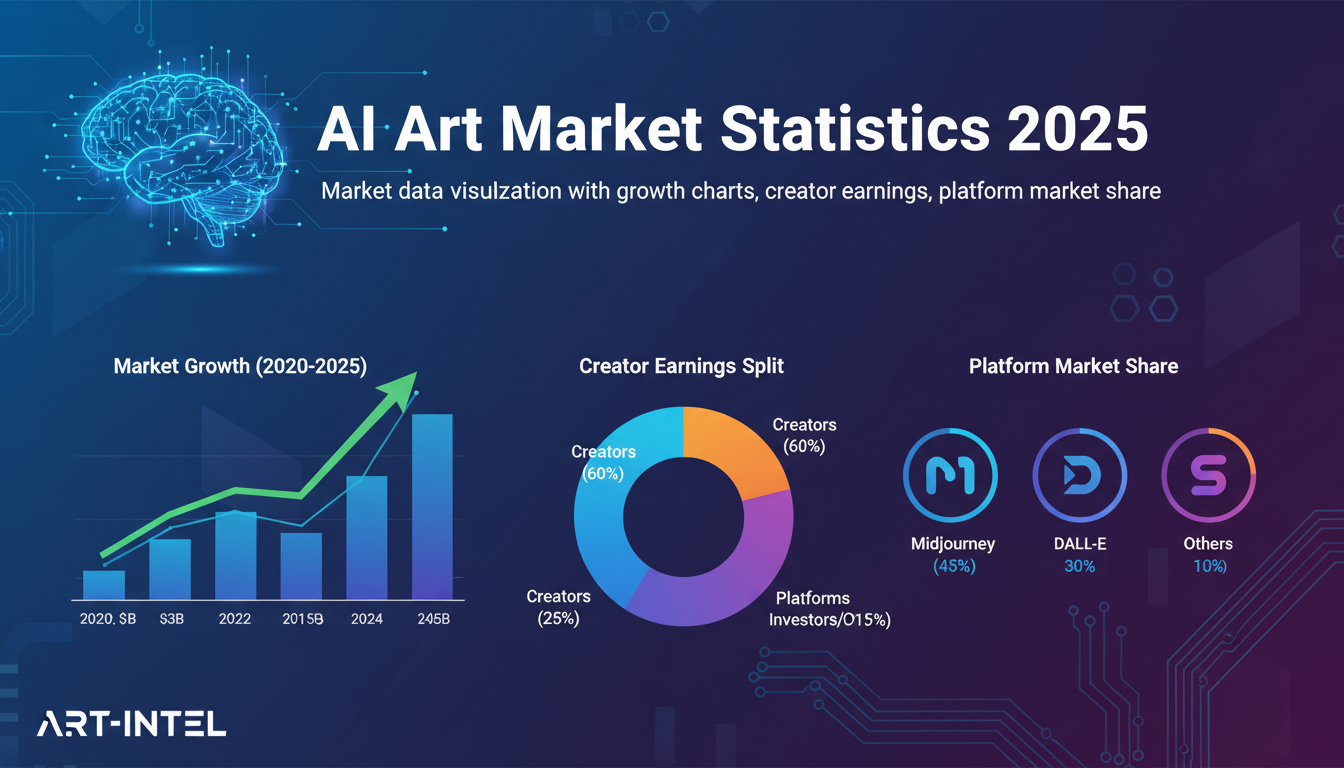
AI Art Market Statistics 2025: Industry Size, Trends, and Growth Projections
Comprehensive AI art market statistics including market size, creator earnings, platform data, and growth projections with 75+ data points.