Open Source AI Image Generators: Free Tools for Creative Freedom
Explore the best open source AI image generators. From Stable Diffusion to Flux 2, learn how to run powerful image generation locally for free.
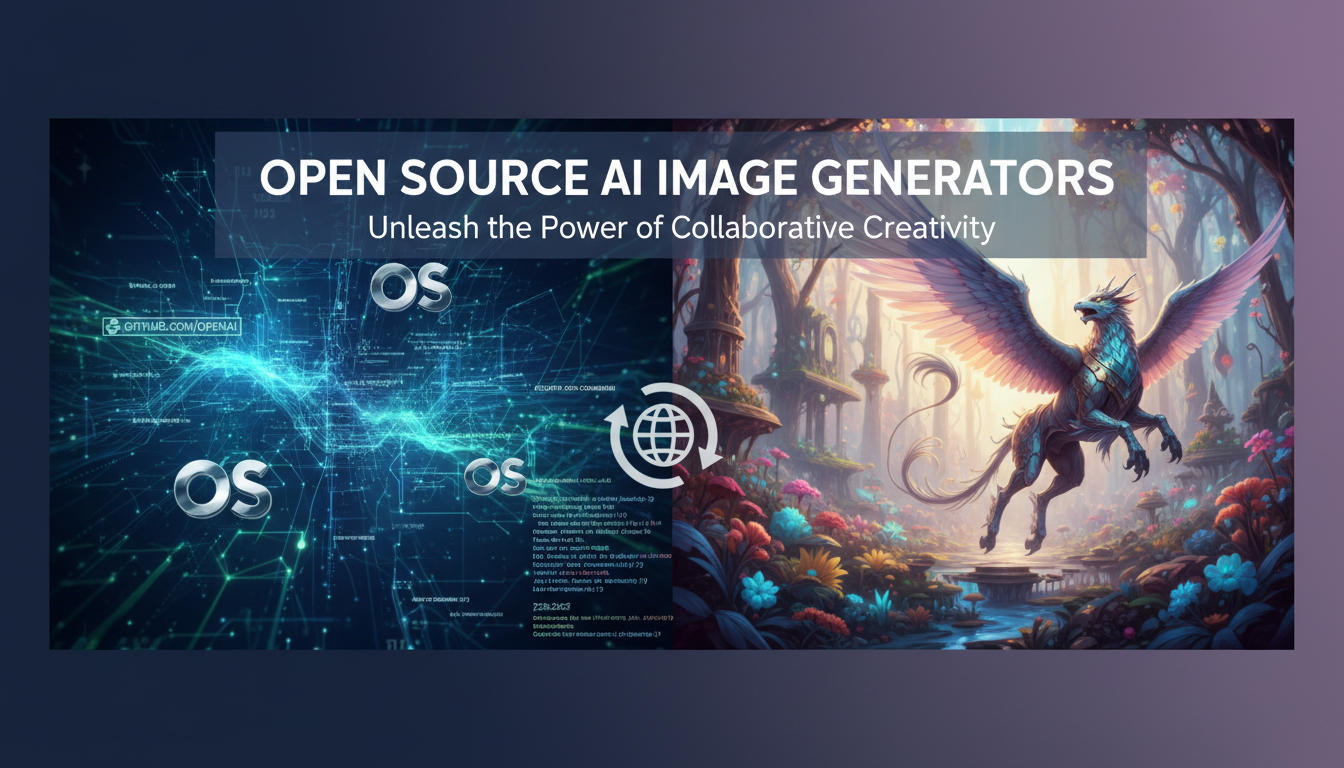
Something shifted in the AI image generation world over the past year, and it happened quietly. Open source models stopped being the scrappy underdogs chasing commercial platforms and started setting the pace. I noticed this during a client project last fall when I realized the images I was generating locally with Flux 2 were consistently better than what I was getting from a $30/month subscription service. That was the moment I cancelled my last paid plan and went fully open source.
Quick Answer: Open source AI image generation has reached a point where local tools like Stable Diffusion XL, Flux 2, and SD 3 can match or exceed commercial alternatives for most use cases. The best way to get started is installing ComfyUI, downloading a model from Hugging Face, and running everything on your own hardware for zero ongoing cost. If you want cloud-based access without local setup, platforms like Apatero let you run these same open source models with a simpler interface.
- Open source AI image generators now rival commercial tools in quality and often surpass them in flexibility
- Stable Diffusion XL, Flux 2, and SD 3 are the three leading open source models worth learning
- ComfyUI is the recommended interface for running open source models locally in 2026
- You need an NVIDIA GPU with 8-12GB VRAM for a comfortable local experience
- The open source ecosystem (LoRAs, ControlNet, community models) provides customization impossible with closed platforms
- Running models locally gives you direct model access, no subscriptions, and complete privacy
Why Open Source Matters for AI Image Generation
The argument for open source AI image generation goes deeper than "it's free," though that's certainly a compelling starting point. When you run an open source model on your own hardware, you gain a level of control and ownership that commercial platforms simply cannot offer. Your prompts stay private. Your generated images belong entirely to you. And there's no company that can suddenly change the terms of service, raise prices, or shut down the platform.
I learned this lesson the hard way. In early 2025, I was heavily invested in a commercial image generation platform that suddenly introduced new content restrictions that broke half my workflows. Projects I'd built prompt templates for over months became unusable overnight. Since switching to open source tools, I've never had that problem. The model on my hard drive works the same way today as it did when I downloaded it, and it will work the same way next year.
There's also a philosophical dimension worth considering. Open source AI image generation democratizes creative tools in a way that closed platforms don't. A student in Lagos has access to the exact same models as a design studio in New York. The playing field is genuinely level, limited only by hardware access rather than subscription budgets. Organizations like Stability AI and Black Forest Labs have released their models openly, believing that broad access produces better outcomes for everyone.
The practical advantages compound over time. When you understand the underlying technology because you're running it directly, you become a better prompt engineer and a more versatile creator. You can fine-tune models, swap components, chain workflows together, and push the boundaries of what's possible in ways that a web app with a text box simply doesn't allow.
The Top Open Source Models You Should Know
Choosing the right model is the single most important decision in your open source AI image generation journey. Each major model has distinct strengths, and understanding those differences will save you hours of frustration. I've spent months testing all of these extensively, and here's what I've found.
Stable Diffusion XL (SDXL)
SDXL remains the workhorse of the open source community. Released by Stability AI, it offers an incredible combination of quality, speed, and ecosystem support. The model generates 1024x1024 images natively and produces results that genuinely compete with commercial platforms across most categories.
What makes SDXL special isn't just the base model. It's the ecosystem. There are thousands of fine-tuned variants on CivitAI and Hugging Face, each specialized for different styles. Want photorealistic portraits? There's a fine-tune for that. Anime illustrations? Dozens of options. Architectural visualization? Multiple community models excel at it.
I still reach for SDXL when I need reliability and broad style coverage. It runs comfortably on 8GB VRAM cards, generation times are fast (under 10 seconds on an RTX 4070), and the community support means you can find help for virtually any problem you encounter.
Flux 2
Flux 2, developed by Black Forest Labs, is the model that changed my mind about whether open source could truly beat commercial alternatives. Its prompt adherence is genuinely remarkable. When I type "a red bicycle leaning against a white picket fence with exactly three sunflowers in the background," I get exactly that. Not two sunflowers, not four. Three. This level of precision was unheard of in open source models just a year ago.
The photorealism is similarly impressive. I ran a blind test with colleagues where I mixed Flux 2 outputs with real photographs, and the identification accuracy was barely above random chance. For commercial work, product photography mockups, and anything where realism matters, Flux 2 is my first choice.
The tradeoff is resource requirements. Flux 2 wants 12GB+ VRAM for comfortable operation, and generation times are longer than SDXL. But if you have the hardware, the results justify the extra resources. You can explore how Flux 2 compares to other options in my comprehensive AI image generator comparison.
Stable Diffusion 3 (SD 3)
SD 3 brought significant improvements in text rendering and compositional understanding. If you've ever tried to generate an image with readable text in it using older models, you know how frustrating it can be. SD 3 handles text remarkably well, making it ideal for mockups, posters, and any design work that incorporates typography.
The architecture is different from SDXL, using a novel approach called "rectified flow" that produces cleaner images with fewer steps. In practice, this means faster generation without sacrificing quality. I've been using SD 3 specifically for projects that require text integration, and it's transformed what I can accomplish without opening Photoshop.
Playground v3
Playground v3 deserves mention as an impressive newcomer that focuses specifically on aesthetic quality. Where other models optimize for prompt adherence or photorealism, Playground v3 prioritizes making images that simply look beautiful. The lighting, color palettes, and compositions tend to have an intentional, almost art-directed quality.
I've found it particularly useful for social media content and marketing materials where visual appeal matters more than technical accuracy. It's not as versatile as SDXL or Flux 2, but when you want something that looks stunning with minimal prompt engineering, Playground v3 delivers consistently.
The Best Interfaces for Running Open Source Models
Having a great model is only half the equation. You need an interface to actually run it, and the choice of interface dramatically affects your experience. I've tested all three major options extensively, and my recommendation has changed over the past year.
ComfyUI: The Power User's Choice
ComfyUI has become my daily driver, and I recommend it as the default choice for anyone serious about open source AI image generation. The node-based workflow system looks intimidating at first glance, but it offers unmatched flexibility once you understand the basics. You can chain models together, add post-processing, build complex conditional workflows, and share your entire setup as a single file.
The performance advantages are real too. ComfyUI uses significantly less VRAM than other interfaces because it loads only what each workflow needs. On my RTX 3060 12GB, I can run workflows in ComfyUI that would crash in other interfaces. If you're new to ComfyUI, my beginner's guide will have you generating images within 10 minutes.
Automatic1111 Web UI
Automatic1111 (often called A1111) was the original king of Stable Diffusion interfaces, and it still has its place. The traditional web UI layout with text boxes, sliders, and dropdown menus is more immediately familiar to most people than ComfyUI's node graph. If you've used any web-based AI image generator, A1111 will feel comfortable right away.
The extension ecosystem is massive. There are extensions for inpainting, outpainting, batch processing, training, upscaling, and dozens of other capabilities. However, A1111 development has slowed compared to ComfyUI, and some newer models require workarounds or community patches to run properly.
I still recommend A1111 for people who want the simplest possible path to generating images locally. The learning curve is gentler, and for basic generation tasks, it works perfectly well.
Forge: The Performance-Optimized Fork
Forge started as a fork of A1111 focused on performance optimization, and it has become its own thing. It offers the familiar A1111 interface but with significantly better memory management, faster generation times, and native support for newer models like Flux 2. Think of it as A1111 with a turbocharger.
If you like the A1111 experience but want better performance and newer model support, Forge is the natural upgrade path. I switched several of my less technical friends from A1111 to Forge, and every one of them noticed the speed improvement immediately.
Hardware Requirements: What You Actually Need
One of the biggest barriers to open source AI image generation is the hardware question. Let me cut through the confusion and give you straightforward guidance based on my testing across multiple GPU configurations.
The GPU is the bottleneck. Everything else (CPU, RAM, storage) matters less for image generation. Here's what you need at each level.
Entry Level (Budget under $200 used): An NVIDIA RTX 3060 12GB is the best value proposition in AI image generation. The 12GB of VRAM lets you run every current model, and you can find them for $150-200 on the used market. Generation times are reasonable at 8-15 seconds for SDXL at 1024x1024. I ran this card for over a year and completed serious production work with it.
Mid Range ($300-500): An RTX 4060 Ti 16GB or RTX 4070 gives you faster generation, more VRAM headroom for larger images, and the ability to run Flux 2 without optimizations. This is the sweet spot for anyone who generates images regularly.
High End ($700+): An RTX 4080 or 4090 makes generation feel instant. SDXL images come back in 3-4 seconds, and even Flux 2 at high resolution stays under 10 seconds. If image generation is a core part of your business, this investment pays for itself in time saved.
No GPU? No problem. If you don't have compatible hardware, you have options. Google Colab provides free GPU access for running notebooks. Platforms like Apatero let you access open source models through a web interface. And cloud GPU services like RunPod and Vast.ai offer rental GPUs for pennies per hour.
For AMD GPU users, the situation has improved but still isn't great. ROCm support works on Linux with certain card families, but the experience is rougher than NVIDIA. If you're buying hardware specifically for AI generation, NVIDIA remains the safe choice.
Getting Started: Installation in Under 30 Minutes
Setting up a local open source AI image generation environment is easier than most people expect. I've helped dozens of people through this process, and the common thread is that everyone thinks it will be harder than it actually is. Here's the streamlined path I recommend.
Step 1: Install ComfyUI. Download ComfyUI Desktop from the official GitHub repository. The desktop version handles Python dependencies automatically, so you don't need to touch a command line. On Windows, it's a standard installer. On Mac and Linux, follow the brief instructions in the README. The whole process takes about 5 minutes.
Step 2: Download a model. Head to Hugging Face and download SDXL Base 1.0 as your starting point. It's a single file (about 6.5GB) that goes into ComfyUI's models/checkpoints folder. For your first download, stick with the official release rather than community fine-tunes.
Step 3: Run your first generation. Open ComfyUI, load the default workflow, and type a prompt. Click "Queue Prompt" and wait. Your first image should appear within 15-30 seconds depending on your hardware. Congratulations, you're now running open source AI image generation locally.
Step 4: Explore and expand. Once you're comfortable with basic generation, start exploring community models on CivitAI, experiment with different samplers and step counts, and check out my guide on LoRA training to understand how you can customize models for your specific needs.
The beauty of this setup is that once it's running, you never need to pay for image generation again. Every image you create is free, private, and unrestricted.
The Community Ecosystem: Your Secret Weapon
The open source AI image community is one of the most active and generous creative communities I've ever been part of. The sheer volume of shared resources, knowledge, and tools available for free is remarkable, and it's what truly sets open source apart from commercial alternatives.
CivitAI and Hugging Face
CivitAI is the central hub for community-created models, LoRAs, and resources. Think of it as an app store for AI image generation styles. Want a model that specializes in watercolor illustrations? Someone has probably fine-tuned one and shared it for free. Need a LoRA that adds a specific character or style to your generations? There are tens of thousands available.
Hugging Face serves as the more technical counterpart, hosting official model releases and providing the infrastructure for model distribution. Most major open source models are distributed through Hugging Face first, and the platform's model cards provide detailed documentation on capabilities and limitations.
I spend at least an hour each week browsing new releases on both platforms. Some of my best creative discoveries have come from stumbling across a community LoRA that does something I didn't even know was possible.
ControlNet and Advanced Control
ControlNet changed everything about how precise you can be with open source AI image generation. Instead of hoping your prompt produces the right composition, ControlNet lets you provide structural guidance through depth maps, edge detection, pose skeletons, and other control signals.
In practical terms, this means you can sketch a rough layout, feed it to ControlNet, and get a polished image that follows your composition exactly. I use this constantly for client work where specific layouts are non-negotiable. It's the feature that convinced me open source could fully replace commercial tools for professional work.
LoRA Training and Customization
LoRAs (Low-Rank Adaptation models) are small files that modify a base model's behavior without replacing it. You can train a LoRA on your own images to create a personalized style, teach the model to generate a specific person's likeness, or fine-tune for a particular aesthetic.
Training a LoRA requires just 10-30 reference images and about 30 minutes of GPU time. The result is a small file (typically 50-200MB) that you can combine with any compatible base model. I've trained LoRAs for specific product lines, brand styles, and even my own face for testing purposes. The customization possibilities are genuinely limitless.
If you're curious about getting started with LoRA training, I wrote a comprehensive beginner's guide that walks through the entire process.
Open Source vs. Commercial Tools: An Honest Comparison
I want to be fair here because I think the open source community sometimes oversells the current state of things. Open source AI image generation has real advantages and real limitations compared to commercial platforms, and understanding both will help you make the right choice.
Where open source wins decisively. Cost (free vs. $10-60/month), privacy (local vs. cloud), customization (full model access vs. fixed options), flexibility (unlimited workflows vs. preset features), and freedom from content restrictions. For anyone who generates images regularly, the savings alone justify the switch. I estimated I've saved over $600 in subscription fees since going fully open source.
Where commercial tools still have an edge. Convenience is the big one. Opening a browser, typing a prompt, and getting a result in 3 seconds is hard to beat. Midjourney's aesthetic quality for artistic work is still arguably the best available, and their community curation surfaces beautiful images effortlessly. DALL-E 3's integration with ChatGPT makes conversational image generation accessible to everyone. And commercial platforms handle all the infrastructure, updates, and optimization for you.
Hot take number one. I think the convenience gap is the only thing keeping commercial platforms competitive at this point. The quality gap has effectively closed. Most people paying $30/month for Midjourney could get equivalent results from Flux 2 running locally, but they value the simplicity of a Discord command over the power of a local setup. And that's a legitimate preference.
Hot take number two. Within two years, the best open source models will be unambiguously better than every commercial offering. The rate of improvement in open source is accelerating, while commercial platforms are constrained by business considerations like content moderation, compute costs, and shareholder expectations. Open source development is driven purely by capability, and that focus advantage compounds over time.
For a detailed side-by-side comparison of specific tools, including commercial options, check out my complete AI image generator comparison for 2026. And if you want to explore free options beyond just open source, my guide to free AI image creators covers cloud-based free tiers as well.
Practical Tips from Hundreds of Hours of Testing
After running open source models for over a year as my primary creative toolset, I've accumulated a collection of practical wisdom that I wish someone had told me at the beginning.
Prompt structure matters more than prompt length. Early on, I wrote paragraph-long prompts thinking more detail meant better results. It doesn't. A well-structured prompt with clear subject, action, environment, and style descriptors in 15-30 words consistently outperforms a 100-word essay. The models have been trained to respond to specific token patterns, and diluting your intent with filler words actually degrades output quality.
Save your workflows, not just your images. In ComfyUI, I save every workflow that produces great results. When a client comes back with a similar request months later, I load the workflow, tweak the prompt, and I'm done in minutes instead of hours. This approach has made my open source setup more productive than any commercial platform I've ever used. Apatero also lets you save and share workflows if you prefer a cloud-based approach.
Learn to read generation metadata. Every image you generate locally includes metadata about the prompt, model, sampler, and settings used. I've learned more about what works by studying the metadata of my best generations than from any tutorial. When something looks great, figure out why, and when something looks wrong, check the settings before blaming the prompt.
Start with the default settings. Every time I test a new model, I run it with completely default settings first. Only after establishing a baseline do I start tweaking samplers, CFG scale, step counts, and other parameters. This discipline prevents the common trap of changing five variables at once and having no idea which one made the difference.
Batch processing is your friend. Generate 4-8 variants of every prompt and pick the best one. AI image generation is inherently probabilistic, and the best image from a batch of eight is almost always significantly better than a single generation. This is an area where local generation truly shines because there's no cost per image.
Who Should Switch to Open Source (And Who Shouldn't)
Open source AI image generation isn't for everyone, and I think being honest about that is more useful than pretending it's universally superior. Here's my candid assessment.
You should switch if you generate more than 50 images per month, care about privacy, want full creative freedom without content restrictions, enjoy learning technical tools, or want to eliminate subscription costs. The upfront investment in learning pays back quickly, and the long-term savings are substantial.
You might want to stay with commercial tools if you generate images occasionally (fewer than 20 per month), don't own a capable GPU and don't want one, need the absolute simplest workflow possible, or primarily create artistic/aesthetic content where Midjourney's style advantage matters to you.
Hot take number three. If you're a professional designer or content creator who uses AI images daily and you're still paying for a commercial subscription, you're leaving money on the table and limiting your capabilities. The learning curve for ComfyUI is about a weekend. The payoff lasts forever.
Frequently Asked Questions
What is the best open source AI image generator in 2026?
For most users, Flux 2 offers the best combination of quality, prompt adherence, and photorealism among open source options. If you prioritize ecosystem size and community support, SDXL remains the most practical choice because of its enormous library of fine-tunes and LoRAs. The "best" choice depends on your specific needs, hardware, and use case.
Can open source AI image generators match Midjourney quality?
Yes, for most categories. In blind testing I've conducted, Flux 2 matches or exceeds Midjourney for photorealism and prompt accuracy. Midjourney still has an edge in pure aesthetic quality for artistic and fantasy imagery, but the gap has narrowed significantly. For commercial and technical work, open source models are already ahead.
What hardware do I need for open source AI image generation?
The minimum practical setup is an NVIDIA GPU with 8GB VRAM, such as an RTX 3060 12GB (which is actually the best budget option). This lets you run SDXL and most community models comfortably. For Flux 2, 12GB+ VRAM is recommended. CPU-only generation is possible but impractically slow for regular use.
Is open source AI image generation truly free?
Yes, the models themselves are completely free to download and use. Your only costs are hardware (which you may already own) and electricity. There are no subscriptions, per-image charges, or hidden fees. Once you've set up your environment, every image you generate is free forever.
How do I install Stable Diffusion locally?
The easiest path in 2026 is installing ComfyUI Desktop, which handles all dependencies automatically. Download it from GitHub, install it like any application, download an SDXL model from Hugging Face, place it in the models folder, and start generating. The whole process takes under 30 minutes even if you've never done anything like it before.
What is ControlNet and why does it matter?
ControlNet is a technology that gives you precise structural control over AI-generated images. Instead of relying solely on text prompts, you can provide depth maps, edge outlines, pose skeletons, or other visual guides. This makes open source generation viable for professional work where specific compositions and layouts are required.
Can I use open source AI images commercially?
Most major open source models (SDXL, Flux 2, Playground v3) come with licenses that permit commercial use of generated images. However, always check the specific license of the model you're using. Some fine-tunes and community models may have additional restrictions. The images you generate are generally yours to use however you want.
How does open source AI image generation compare to DALL-E?
Open source models generally produce higher quality results than DALL-E 3, particularly in photorealism and style variety. DALL-E's advantage is its integration with ChatGPT, making it extremely easy to use through conversation. If convenience is your priority, DALL-E wins. If quality, customization, and cost matter more, open source is the better choice.
What are LoRAs and how do they enhance open source models?
LoRAs are small, trainable add-ons that modify a base model's behavior. They can teach a model new styles, subjects, or concepts using as few as 10-30 training images. LoRAs are typically 50-200MB in size and can be mixed and matched with different base models. They're what make open source AI image generation endlessly customizable.
Is my data private when using open source AI image generation locally?
Completely. When you run models on your own hardware, nothing leaves your computer. Your prompts, generated images, and usage patterns are entirely private. This is one of the strongest arguments for open source generation, particularly for businesses working with sensitive or proprietary content.
Final Thoughts
The state of open source AI image generation in 2026 is remarkable. What was once a niche hobby for technically minded enthusiasts has become a legitimate professional toolset that rivals and often exceeds what commercial platforms offer. The models are world-class. The interfaces are mature. The community is vibrant and generous. And the cost of entry has never been lower.
If you've been curious about open source AI image generation but felt intimidated by the technical requirements, now is the time to dive in. Start with ComfyUI and an SDXL model. Generate your first image. And then explore from there. The learning curve is gentler than you expect, and the creative freedom on the other side is worth every minute invested.
For those who want the benefits of open source models without the local setup, Apatero provides cloud access to the same models through a friendlier interface. Either way, the era of paying $30/month for AI image generation when equivalent tools are freely available is ending. The only question is whether you'll be an early adopter or a late follower.
Some models you cannot download at any VRAM
Veo, Kling and Nano Banana have closed weights. There is no local build, no quantization, no 24GB workaround. Run them in the browser instead. Check current model access and generation costs in the app.
Related Articles
5 Proven AI Influencer Niches That Actually Make Money in 2025
Discover the most profitable niches for AI influencers in 2025. Real data on monetization potential, audience engagement, and growth strategies for virtual content creators.
AI Background Replacement: Professional Guide 2025
Master AI background replacement for professional results. Learn rembg, BiRefNet, and ComfyUI workflows for smooth background removal and replacement.
AI Character Consistency: How to Maintain Virtual Persona Identity Across Content
Learn techniques for maintaining AI character consistency across hundreds of images. Master the art of creating recognizable virtual personas with consistent visual identity.