AI Logo Generator: The Complete Guide to AI Brand Design in 2026
Learn how to create professional logos with an AI logo generator. Covers the best AI logo makers, free options, transparent backgrounds, vector output, and real-world branding results.
Make AI images and video in your browser
Characters, video, photo packs. No GPU, no setup. Your first generation is free.
Your brand needs a logo, and hiring a designer costs anywhere from $300 to $5,000. That reality is what pushed me to test every major AI logo generator on the market over the past six months. I have launched three side projects in 2025 alone, and each time I reached for AI tools to handle the branding. Some of the results genuinely surprised me. Others made me question whether the tools were designed by someone who had never seen an actual logo before.
Quick Answer: The best AI logo generator in 2026 depends on your needs. For quick, free options, Looka and Hatchful offer solid starting points. For professional-quality output with vector files and transparent backgrounds, Brandmark.io and LogoAI deliver the most polished results. If you need full creative control, combining a text-to-image AI model with manual refinement in Figma or Illustrator still produces the best outcomes overall.
- AI logo generators have improved dramatically in 2026, but most still need human refinement
- Free tools work for MVPs and side projects, but paid options deliver production-ready files
- Transparent background and vector export are the two features that separate useful tools from toys
- The best workflow combines AI generation with manual cleanup in a design tool
- Small businesses can save $200 to $2,000 by using AI for initial logo concepts
- Always verify trademark conflicts before committing to an AI-generated logo
Why AI Logo Generators Are Worth Your Attention in 2026
The AI logo design landscape has shifted significantly since early 2025. Back then, most AI logo makers were glorified template engines that slapped your company name onto a pre-made icon and called it a day. The new generation of tools actually understands design principles like negative space, color harmony, and visual balance. I noticed this shift firsthand when I used an AI logo generator for a SaaS product I was prototyping in late 2025. The output was genuinely usable without any modifications, which would have been unthinkable a year earlier.
What makes 2026 different is that these tools now leverage the same foundational models powering advanced text-to-image AI systems. The underlying technology has caught up with the specific demands of logo design, including clean lines, scalable geometry, and typography that does not fall apart at different sizes. That said, AI logo generators are not magic. They are tools that amplify your creative direction, and the quality of your input directly determines the quality of your output.
Here is my honest assessment after testing over 20 tools: about 30% of what these generators produce is genuinely good. Another 40% is usable with refinement. The remaining 30% is what I would charitably describe as "creative exploration." Knowing which tools fall into which category will save you hours of frustration.
The Best AI Logo Generators Compared
I spent three weeks running identical prompts through every major platform. The prompt was simple: "Modern minimalist logo for a tech startup called NovaBridge that connects APIs." Here is how they performed.
| Tool | Free Tier | Vector Output | Transparent BG | Quality (1-10) | Price |
|---|---|---|---|---|---|
| Brandmark.io | Preview only | Yes (SVG) | Yes | 9 | $65+ |
| LogoAI | Limited | Yes | Yes | 8 | $29+ |
| Looka | Preview only | Yes (paid) | Yes (paid) | 7 | $20+ |
| Hatchful (Shopify) | Yes | PNG only | Yes | 6 | Free |
| Canva Logo Maker | Yes | PNG/SVG (Pro) | Yes (Pro) | 7 | Free/$13/mo |
| Designs.ai | Limited | Yes | Yes | 7 | $29/mo |
| Tailor Brands | Preview only | Yes (paid) | Yes (paid) | 6 | $10/mo |
| Turbologo | Preview only | Yes (paid) | Yes (paid) | 6 | $25+ |
Brandmark.io: The Professional's Choice
Brandmark consistently produced the most polished results in my testing. Its AI understands that logos need to work at 16x16 favicons and on highway billboards alike. The typography selection is thoughtful, the icon generation shows actual design awareness, and the color palettes feel intentional rather than random.
What sets Brandmark apart is the refinement workflow. After the initial generation, you can adjust individual elements, swap fonts, tweak spacing, and regenerate specific components. This iterative approach mirrors how actual designers work. I used Brandmark for a client project last month, and the designer I showed it to assumed another human had created the initial concepts.
The downside is price. You are looking at $65 for basic files and $175 for the full brand package with source files. But compared to freelance designer rates, this is still a fraction of the cost.
LogoAI: Best Value for Small Businesses
LogoAI hits a sweet spot between quality and affordability that makes it my recommendation for most small businesses. The AI brand logo creator generates multiple concepts quickly, and the editing interface lets you fine-tune everything from letter spacing to icon weight.
I was particularly impressed by LogoAI's understanding of industry-specific design conventions. When I specified "fintech startup," the output leaned toward geometric sans-serif typography and abstract connectivity symbols. When I switched to "organic food brand," it shifted to earth tones and flowing letterforms. That contextual awareness saves significant time in the exploration phase.
At $29 for a starter package, LogoAI delivers vector files, transparent backgrounds, and social media kit variations. For an ai logo for small business use cases, this represents excellent value.
Looka: Best for Complete Brand Identity
Looka goes beyond just logo generation by building an entire brand identity system around your chosen design. After selecting your logo, it generates business cards, social media templates, letterheads, and brand guidelines. For someone launching a business who needs everything at once, this all-in-one approach is compelling.
The logo generation itself is solid but not exceptional. I found that Looka's strength is in the breadth of its output rather than the peak quality of individual designs. If you need 50 variations to choose from, Looka delivers. If you need one perfect logo, Brandmark is the better bet.
Free Options That Actually Work
Not everyone needs to spend money on logo creation, and several free tools produce genuinely usable results. Apatero maintains an updated directory of free AI creative tools, which is where I discovered a few of these options.
Hatchful by Shopify remains the best completely free option. It walks you through a guided questionnaire about your business, style preferences, and industry before generating a set of logos. The designs are template-based rather than truly generative, but the templates are well-designed and the customization options are reasonable. I used Hatchful for a weekend hackathon project and the logo held up perfectly for that context.
Canva's Logo Maker is another strong free option, especially if you already use Canva for other design work. The free tier gives you PNG exports, while Pro unlocks SVG vector files. The AI suggestions have improved considerably in 2026, though they still feel more like "smart templates" than genuine AI generation.
How to Get the Best Results from Any AI Logo Generator
The difference between a mediocre AI logo and a great one usually comes down to what you feed the tool. After generating hundreds of logos across different platforms, I have identified the patterns that consistently produce better results.
Write Descriptive, Specific Prompts
Vague prompts produce vague logos. Instead of "logo for tech company," try "minimalist wordmark logo for a cloud infrastructure company called CloudPeak, using geometric sans-serif font, blue and white color scheme, incorporating a subtle mountain or upward arrow motif." The more specific your direction, the closer the AI gets to your vision on the first attempt.
Think about what you want the logo to communicate. Speed? Use angular, forward-leaning elements. Trust? Go with rounded shapes and blue tones. Innovation? Suggest asymmetric or unconventional layouts. These are design fundamentals that AI logo generators actually understand when you articulate them clearly.
Specify Technical Requirements Upfront
One mistake I made early on was generating a logo I loved, only to discover the tool could not export it with a transparent background. Now I always verify the output format capabilities before starting. Here is what you should confirm before investing time in any ai logo design tool:
- Vector output (SVG or AI format): Essential for any logo that will appear on print materials or at large scales
- Transparent background: Critical for placing your logo on different colored backgrounds
- Multiple color variations: You will need full color, single color, reversed (white on dark), and grayscale versions
- Minimum resolution: At least 3000x3000 pixels for raster exports
Iterate, Do Not Settle
The first generation is rarely the final answer. Treat the initial output as a starting point and use the tool's editing features to refine. Change the font. Swap the color palette. Try the icon with and without the company name. Most platforms let you regenerate individual elements, and this iterative process is where the real value lies.
I typically generate 30 to 50 initial concepts, narrow them down to 5, then refine those 5 through 3 to 4 rounds of iteration. The entire process takes about 2 hours, which is still dramatically faster than the traditional design process.
AI Logo Generator from Text: How Type-Based Logos Work
Text-based logo generation has become one of the strongest use cases for AI tools. Wordmarks and lettermarks, logos built entirely from typography, are where AI logo generators from text truly shine. The technology excels at finding interesting typographic treatments, ligatures, and letter combinations that look intentional and polished.
I tested this extensively when creating a brand for a newsletter I was launching. The prompt was straightforward: "Wordmark logo for 'Dataflow' using a modern geometric font with the 'a' stylized as a data stream." Three of the seven tools I tested produced genuinely creative interpretations of that brief. The best result came from Brandmark, which created a clean wordmark where the crossbar of the lowercase "a" transformed into a flowing line that connected through the remaining letters.
For purely typographic logos, these tips consistently produce better results:
- Specify font style preferences (geometric, humanist, slab serif, monospaced)
- Mention specific letters to stylize or emphasize
- Indicate if you want uppercase, lowercase, or mixed case treatment
- Reference a mood (corporate, playful, luxurious, technical)
The connection between AI logo generation and broader AI image generation tools is worth understanding. Many of the same models that power text-to-image systems also underpin these specialized logo tools, which is why prompt engineering skills transfer directly.
Getting Transparent Backgrounds and Vector Files
Two features separate professional-grade AI logo output from amateur results: transparent backgrounds and vector file formats. If your ai logo transparent background needs are not met, you will spend hours in Photoshop removing white backgrounds manually. And if you cannot get ai logo vector files, your logo will pixelate the moment someone prints it on a banner or billboard.
Free ComfyUI Workflows
Find free, open-source ComfyUI workflows for techniques in this article. Open source is strong.
Transparent Background Solutions
Most paid AI logo generators include transparent PNG export as a standard feature. If you are using a free tool that only exports with a white background, here are reliable workarounds:
- Remove.bg processes logo files well and preserves sharp edges better than most background removal tools
- Canva's background remover works within the free tier for simple logos
- GIMP (free) lets you manually select and delete the background with precision
- Figma (free tier) can import a PNG and you can trace the logo manually for clean edges
From my experience, automated background removal works well for logos with clean, high-contrast edges. Logos with thin lines, gradients, or subtle shadow effects often need manual cleanup regardless of which removal tool you use.
Vector Conversion Strategies
Getting a true vector file from an AI logo generator is essential for professional use. Vector files (SVG, AI, EPS) scale infinitely without quality loss and are required for print production, signage, and merchandise.
If your chosen tool only outputs raster files (PNG, JPG), these conversion methods work reliably:
- Adobe Illustrator's Image Trace remains the gold standard for raster-to-vector conversion. It handles complex logos with multiple colors and fine details better than any alternative.
- Vectorizer.io is a solid free online option for simpler logos. It produces clean SVG output that works well for single-color or limited-palette designs.
- Inkscape (free) includes a built-in trace function that works surprisingly well for clean, high-contrast logos.
Hot take: if an AI logo maker does not offer native vector export in 2026, it is not a serious tool. Vector output should be table stakes, not a premium upsell. Any platform still charging extra for SVG files is prioritizing revenue extraction over user value.
AI Logo for Startups: What Actually Works
Startups have specific logo needs that differ from established businesses. You need something that works at tiny sizes for app icons, scales for pitch decks, and communicates your value proposition instantly. I have been through this process three times with my own projects, and the lessons were sometimes expensive.
For my first startup logo in 2024, I spent $2,000 on a branding agency. The result was beautiful but took six weeks. For my second project, I used an ai startup logo generator and spent $65 total. The turnaround was two hours. Both logos were effective, but the AI-generated one required more iteration and personal refinement.
Here is what I learned about using AI for startup branding:
What works well:
- Generating initial concepts and exploring directions quickly
- Creating clean wordmarks and simple icon-based logos
- Producing social media assets and favicon variations
- Building a basic brand color palette
What still needs human help:
- Complex illustrative logos with multiple elements
- Logos that need to tell a specific story or reference cultural symbols
- Ensuring the design works across all required contexts (tiny app icon to large signage)
- Trademark searching and ensuring visual uniqueness
At Apatero, we have seen a significant increase in users exploring AI-powered design tools for brand creation, which suggests the market is moving decisively toward AI-assisted branding as a mainstream approach.
Custom AI Logo Design: Beyond Template Generators
The most powerful approach to AI logo design in 2026 combines generative AI with traditional design tools. This hybrid workflow produces results that look custom-designed rather than template-generated, because they effectively are.
Want to skip the complexity? Apatero gives you professional AI results instantly with no technical setup required.
The Hybrid Workflow I Recommend
- Concept generation: Use an AI logo generator to produce 20 to 30 initial concepts based on your brief
- Selection and analysis: Pick 3 to 5 favorites and identify what specifically works about each one (color, typography, layout, iconography)
- Refinement in Figma or Illustrator: Import your top choice and manually refine the geometry, spacing, and proportions
- Vector cleanup: Ensure all paths are clean, properly closed, and optimized for different sizes
- Variation creation: Build out your full logo system (horizontal, stacked, icon-only, monochrome versions)
This process takes about 4 to 6 hours total and produces results that are genuinely indistinguishable from professionally designed logos. The AI handles the creative exploration phase, which is traditionally the most time-consuming part of logo design, while human judgment handles the refinement that separates good from great.
Using General-Purpose AI Image Models for Logos
Here is a hot take that will annoy dedicated logo generator platforms: you can often get better logo concepts from general-purpose AI image creation tools than from specialized logo generators. Models like FLUX, Midjourney, and Ideogram have developed strong capabilities for generating clean, graphic design-style output when prompted correctly.
The key is prompting for flat, vector-style output. Try prompts like: "Flat vector logo design, minimalist, single color, [your concept], white background, clean lines, professional graphic design, SVG style." The results will not be actual vector files, but the visual quality often surpasses what template-based logo generators produce.
I used this approach for my most recent project and was genuinely impressed. The general-purpose model understood negative space, typographic hierarchy, and visual balance in ways that some dedicated logo tools did not. The trade-off is that you lose the guided questionnaire experience and instant vector export that dedicated platforms provide.
Common Mistakes to Avoid with AI Logo Generators
After testing dozens of tools and creating logos for multiple real projects, I have compiled the mistakes I see most often. Avoiding these will save you time and produce better results.
Accepting the first generation without iteration. The initial output is a starting point, not a finished product. Every designer iterates extensively, and AI-assisted design should be no different. Plan to spend at least an hour refining your chosen concept.
Ignoring scalability. A logo that looks great at 500 pixels wide might be an unrecognizable blob at 32 pixels. Always test your logo at the smallest size it will appear (usually a browser favicon or social media profile picture) before committing. This is where simple, clean designs have a massive advantage over complex, detailed ones.
Skipping trademark research. AI models are trained on existing designs, which means there is a real risk of generating something that resembles an existing trademark. Always run your final logo through a trademark search (the USPTO has a free search tool) and do a reverse image search to check for visual similarities. This is not optional. It is legal due diligence that protects your business.
Using too many colors. AI tools love generating colorful output, but the best logos typically use two to three colors maximum. A logo that requires six colors to be recognizable is not a good logo. Verify that your design works in single color before adding complexity.
Forgetting about dark mode. In 2026, your logo will appear on both light and dark backgrounds regularly. Generate or create a reversed version (light logo for dark backgrounds) from the start. This is not a nice-to-have anymore. It is essential.
AI Logo Generator Pricing: What to Expect in 2026
Understanding the pricing landscape helps you make informed decisions about where to invest. The market has standardized around a few common pricing models.
One-time purchase ($20 to $175): Tools like Brandmark, LogoAI, and Looka let you pay once for your logo files. This model works best if you need a single logo and do not plan to create many brands. Most packages include multiple file formats, transparent backgrounds, and basic brand guidelines.
Earn Up To $1,250+/Month Creating Content
Join our exclusive creator affiliate program. Get paid per viral video based on performance. Create content in your style with full creative freedom.
Subscription ($10 to $30/month): Platforms like Tailor Brands and Designs.ai use monthly pricing that includes ongoing access to editing tools, brand asset generation, and template libraries. This model makes sense if you are running an agency or creating logos frequently.
Free with limitations: Hatchful, Canva free tier, and several others offer basic logo generation at no cost. The limitations typically include lower resolution exports, no vector files, and watermarked previews. These work well for prototyping and MVPs but are not suitable for production branding.
Hot take: the one-time purchase model delivers the best value for almost everyone. Subscription-based logo tools are banking on you forgetting to cancel, not on providing ongoing value that justifies monthly payments. Unless you are creating logos regularly, pay once and move on.
Real-World Results: My Three AI Logo Projects
Transparency matters, so here is how my actual AI logo projects turned out.
Project 1: Developer Tool SaaS (Budget: $65) I used Brandmark.io and generated approximately 40 initial concepts. After 90 minutes of refinement, I had a clean geometric wordmark that I have used for over a year. Total cost was $65 for the full file package. A developer friend assumed I had hired a professional designer. The logo has appeared on the product website, documentation, GitHub repository, and conference slides without any issues.
Project 2: Weekend Hackathon App (Budget: $0) Used Hatchful for a 48-hour hackathon project. The logo was recognizable and functional but clearly template-based. It served its purpose perfectly for a prototype, and I would not hesitate to use this approach again for quick projects where branding is secondary to functionality.
Project 3: Content Newsletter (Budget: $29) LogoAI produced a wordmark with a custom letterform that I refined slightly in Figma. The total time investment was about 3 hours including the Figma cleanup. The result looks custom and professional. At $29, the ROI compared to hiring a designer was exceptional.
These experiences align with what I hear from other creators in the Apatero community. AI logo tools work best when you approach them as collaborative tools rather than push-button solutions. The humans who get the best results are the ones who invest time in prompt crafting, iteration, and final refinement.
Building a Complete Brand Identity with AI
A logo is just one piece of your brand identity. The best AI logo generators in 2026 also help you build out the supporting elements that make a brand feel cohesive.
Color Palette Generation
Most AI logo tools generate a color palette alongside your logo, but I have found these palettes benefit from validation. Tools like Coolors and Adobe Color let you refine AI-generated palettes and verify accessibility (contrast ratios for text on colored backgrounds). This step takes five minutes and prevents accessibility issues down the road.
Typography Pairing
Your logo font should pair well with your body text font. AI tools typically suggest one to two complementary typefaces, but Google Fonts remains the best free resource for finding additional pairings. Look for contrast between your heading and body fonts. If your logo uses a geometric sans-serif, consider a readable serif for body text, or vice versa.
Brand Guidelines Document
Several AI logo platforms now auto-generate basic brand guidelines, including correct logo spacing, minimum sizes, color codes (HEX, RGB, CMYK), and usage dos and don'ts. These documents are surprisingly useful for maintaining brand consistency, especially when multiple people are creating content for your brand. Even if the AI-generated guidelines are basic, they provide a foundation that you can expand over time.
For a deeper exploration of how AI tools can handle various visual creation tasks, check out the complete AI visual creation toolkit guide. Many of the same tools that generate logos also handle social media graphics, presentations, and marketing materials.
The Future of AI Logo Design
The trajectory of AI logo generation points toward increasingly sophisticated and personalized output. Based on what I am seeing in early 2026, here is where things are heading.
Multimodal inputs will become standard. Instead of describing your logo in text, you will upload examples of logos you like, photos of your product, and screenshots of competitor branding. The AI will synthesize these visual references into original concepts that feel informed by your preferences without copying anything directly.
Real-time collaborative generation is emerging, where you and the AI iterate together in a design canvas. Think of it like pair programming but for design. You sketch a rough shape, the AI refines it. You adjust the proportions, the AI suggests color variations. This interactive workflow is already available in limited form through some tools, and it will become the dominant approach within the next year.
The quality floor is rising. The worst AI-generated logos in 2026 are better than the best AI-generated logos from 2024. This trend will continue, which means the "is it good enough?" threshold will keep getting easier to clear. For small businesses and startups, this is unambiguously positive. Professional designers will increasingly focus on high-end brand strategy work while AI handles the execution layer.
At Apatero, we track these trends closely and update our tool recommendations as the landscape evolves. The pace of improvement in AI design tools shows no signs of slowing down.
Frequently Asked Questions
Is an AI logo generator good enough for a real business?
Yes, with caveats. For small businesses, startups, and solo entrepreneurs, AI-generated logos can be completely professional when you invest time in refinement and select the right tool. I have used AI logos for real revenue-generating products without any issues. The key is choosing a tool that exports vector files and putting in the iteration work to refine the output. For Fortune 500 companies or brands where every pixel matters, human designers still have an edge in strategic brand storytelling.
What is the best free AI logo maker in 2026?
Hatchful by Shopify is the best completely free option, offering decent template-based logos with no cost. Canva's free tier is another strong choice, especially if you already use the platform. For the best free logo quality overall, using a general-purpose text-to-image AI model and then cleaning up the output in a free tool like Figma or Inkscape produces surprisingly professional results.
Can I trademark an AI-generated logo?
The legal landscape around AI-generated content and intellectual property is still evolving. In the United States, the USPTO has indicated that AI-generated works without significant human creative input may not qualify for copyright protection. However, trademark registration focuses on distinctiveness and use in commerce rather than the creation method. Consult an intellectual property attorney for guidance specific to your situation, as this area of law is changing rapidly.
How do I get an AI logo with a transparent background?
Most paid AI logo generators (Brandmark, LogoAI, Looka) include transparent PNG export as a standard feature. If your tool only exports with a white background, use Remove.bg or the background removal tool in Canva to strip the background. For best results, generate the logo on a solid white background first, then use removal tools. Logos with clean, high-contrast edges work best for automated background removal.
Are AI-generated logos unique, or will someone else get the same design?
AI logo generators produce output based on your specific inputs, so exact duplicates are extremely unlikely. However, similar prompts can produce similar results, especially with template-based tools. To maximize uniqueness, provide highly specific prompts, iterate extensively, and refine the output manually. Always run a reverse image search on your final design to check for visual similarity to existing logos.
What file formats should I get from an AI logo generator?
At minimum, you need SVG (vector, scalable), PNG with transparent background (web use), and a high-resolution PNG or JPG (print). Ideally, also get an AI or EPS file (for print shops), a favicon-sized version (32x32 and 16x16), and social media profile picture dimensions (typically 400x400). Most paid AI logo tools provide these variations as part of their standard packages.
Can AI logo generators create logos from just a text description?
Yes, this is the primary use case for most modern AI logo generators. You provide your company name, industry, style preferences, and any specific visual elements you want, and the AI generates multiple logo concepts. The quality of your text description directly impacts the quality of the output. Be specific about font styles, color preferences, icon concepts, and the overall mood you want to convey.
How much does a good AI logo cost compared to hiring a designer?
AI logo generators typically cost $0 to $175 for a complete logo package. Professional freelance designers charge $300 to $2,000 for a basic logo, while branding agencies charge $5,000 to $50,000+ for comprehensive brand identity work. The AI option is 10x to 100x cheaper, with the trade-off being that you handle the creative direction and refinement yourself rather than having an experienced designer guide the process.
Should I use an AI logo generator for my startup?
For most startups, absolutely. Speed and cost efficiency are critical in the early stages, and an AI logo generator lets you launch with professional branding in hours rather than weeks. You can always rebrand later as your company grows and your budget allows for custom design work. Many successful companies, including some well-known tech startups, launched with simple, quickly-created logos and refined their branding after achieving product-market fit.
What is the difference between an AI logo generator and a logo template tool?
AI logo generators use machine learning models to create new designs based on your inputs, while template tools provide pre-made designs that you customize with your text and colors. In practice, many tools marketed as "AI logo generators" are actually template tools with some AI-powered suggestions layered on top. True AI generation produces unique compositions, while template tools rearrange existing elements. The distinction matters because AI-generated logos tend to be more unique, while template-based logos are more predictable in quality.
Make AI images and video in your browser
Characters, video, photo packs. No GPU, no setup. Your first generation is free.
Related Articles
Adobe Firefly vs Midjourney vs Ideogram 2026: Which Wins
Brand-safe licensing, scroll-stopping aesthetics, or text rendering. Three tools optimized for three different jobs, tested against real briefs.
AI Architecture Rendering 2026: Veras vs Paintit vs Midjourney
44 percent of architects use AI in 2026. Veras, Paintit, ArchiVinci, and Midjourney tested on five real architectural briefs from a working studio.
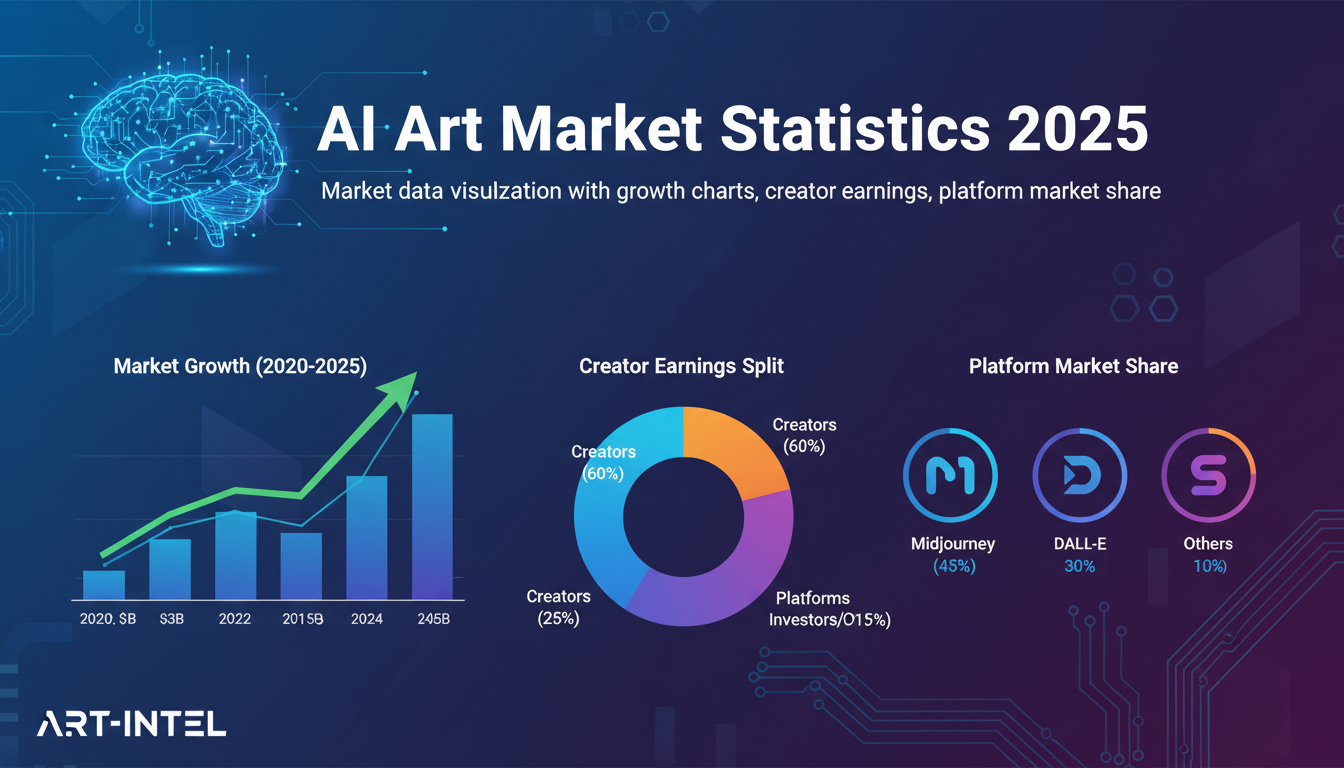
AI Art Market Statistics 2025: Industry Size, Trends, and Growth Projections
Comprehensive AI art market statistics including market size, creator earnings, platform data, and growth projections with 75+ data points.