Stable Diffusion 3.5 Fine-Tunes: Best Community Models Ranked and Tested
I tested dozens of SD 3.5 community fine-tunes across photorealism, anime, illustration, and specialty styles. Here are the best checkpoints ranked by quality, speed, and VRAM usage in 2026.
Some models you cannot download at any VRAM
Veo, Kling and Nano Banana have closed weights. There is no local build, no quantization, no 24GB workaround. Run them in the browser instead. First generation free.
I've been running Stable Diffusion models since the 1.5 days, and I can honestly say that the SD 3.5 fine-tune ecosystem has grown faster than anything I've seen before. Back when SDXL launched, it took months for the first decent community fine-tunes to appear. With SD 3.5 Large and its 2 billion parameters, the community hit the ground running. By early 2026, CivitAI had over 80 SD 3.5 based checkpoints, and new ones keep dropping every week.
The problem? Most of them aren't worth your time. I downloaded and tested 34 different SD 3.5 fine-tunes over the last six weeks, running identical prompt sets across all of them to see which ones actually deliver. Some of these models blew me away. Others were barely distinguishable from the base model. And a few were so bad I genuinely wondered if the creator had even looked at the outputs before uploading.
This guide is the result of all that testing. I'm going to walk you through the best community fine-tunes organized by category, share my benchmarks, and give you honest opinions about which ones deserve a spot on your hard drive.
Quick Answer: The best SD 3.5 fine-tunes in 2026 are RealVision 3.5 XL for photorealism, AnimeMasterV3 for anime, and IllustraForge for digital illustration. SD 3.5 Large fine-tunes offer dramatically better prompt adherence and native typography support compared to older architectures, but they require at least 8GB of VRAM for fp16 and 12GB+ for comfortable generation at high resolutions. The community has figured out how to push these models far beyond what the base checkpoint can do, particularly for specific styles and consistent character rendering.
- SD 3.5 Large fine-tunes now rival and often surpass SDXL models in quality, prompt adherence, and native text rendering
- Photorealism category leaders: RealVision 3.5 XL, TruePhoto SD35, and NaturalFocus produce images that require careful inspection to distinguish from photographs
- Anime and illustration fine-tunes have closed the gap with dedicated anime architectures like NovelAI
- VRAM requirements range from 6GB (fp8 quantized) to 16GB+ (full precision with large batches), making GPU choice critical
- Typography support in SD 3.5 fine-tunes is a genuine differentiator, letting you render readable text directly in generated images
- Most fine-tunes work with ComfyUI, Forge, and the new SD3.5 nodes on Apatero.com for cloud-based generation
If you're new to the world of fine-tuning and want to understand how these models are made, I'd recommend checking out my LoRA training guide for the foundational concepts. But you don't need to know how to train models to use the ones I'm recommending here.
Why Are SD 3.5 Fine-Tunes Such a Big Deal in 2026?
To understand why the SD 3.5 fine-tune scene matters, you need to appreciate what SD 3.5 Large brought to the table. The base model shipped with 2 billion parameters, a multimodal transformer architecture (MMDiT), and three text encoders working in concert: CLIP ViT-L, CLIP ViT-bigG, and T5-XXL. That triple encoder setup means the model understands prompts at a depth that SD 1.5 and even SDXL couldn't touch.
The typography support alone would've been enough to make it special. For years, getting AI models to render readable text was basically impossible. You'd prompt "a coffee mug that says Good Morning" and get gibberish characters that looked like someone sneezed on a keyboard. SD 3.5 can actually read and render text with surprising accuracy, and the fine-tunes have pushed this capability even further.
But the real magic happens when community creators take that powerful base and specialize it. A fine-tuned checkpoint takes the general knowledge of SD 3.5 and sharpens it for specific domains. A photorealism fine-tune learns what actual skin texture, lighting falloff, and lens distortion look like. An anime fine-tune learns the visual language of different art styles, from thick outlines to cel shading to watercolor washes.
I spent a weekend last November trying to get photorealistic skin texture out of the base SD 3.5 checkpoint. It kept giving me this plastic, smoothed-over look no matter how I adjusted the CFG or tweaked my negative prompts. Then I loaded RealVision 3.5 XL for the first time and the difference was immediate. Pores, fine hair, subtle color variations in the skin. It was night and day. That's what a good fine-tune does.
The other thing that's changed the game is accessibility. On platforms like Apatero.com, you can run many of these fine-tuned checkpoints without needing a local GPU at all. That opens the door for creators who don't want to deal with the hassle of downloading 7GB model files and configuring their local setup. Whether you're running locally or in the cloud, these models are more accessible than ever.
The base SD 3.5 Large output (left) vs. RealVision 3.5 XL fine-tune (right) using identical prompts and settings. The fine-tune produces dramatically more realistic skin texture and lighting.
What Are the Best SD 3.5 Photorealism Fine-Tunes?
Photorealism is the category where fine-tuning makes the biggest visible difference, and it's where the competition is fiercest. I tested 12 photorealism-focused fine-tunes, and three stood out from the pack.
RealVision 3.5 XL
This is my top pick for photorealism, and it's not particularly close. The team behind RealVision has been refining their approach since the SD 1.5 era, and their experience shows. RealVision 3.5 XL handles skin tones across all ethnicities with remarkable accuracy. It understands how light interacts with different materials. Fabric wrinkles look natural. Hair has individual strand detail. Glass and metal reflections are physically plausible.
I generated over 200 test images with RealVision 3.5 XL, and the consistency impressed me more than anything. With some fine-tunes, you'll get an amazing result on one seed and a mediocre one on the next. RealVision delivered solid quality across at least 80% of my test prompts, which is an absurdly high hit rate for any model.
The one area where it struggles slightly is extreme close-up portraits. At very tight crops, you'll sometimes see a slight softening around the eye area. But at normal portrait distances and wider compositions, it's currently the best photorealism checkpoint available.
- VRAM requirement: 8GB minimum (fp16), 12GB recommended
- Best resolution: 1024x1024 native, excellent upscaling to 2048x2048
- Speed: ~6.2 seconds per image at 30 steps on an RTX 4090
- Typography: Good, inherits SD 3.5's text rendering with slight improvements
- CivitAI downloads: 185K+
TruePhoto SD35
TruePhoto takes a different approach to photorealism than RealVision. Where RealVision excels at portraits and people, TruePhoto shines in environmental photography and architectural shots. Landscapes, cityscapes, interiors, and product photography all look remarkably natural.
I tested it extensively with product photography prompts, since that's a practical use case a lot of people care about. A prompt like "professional product photo of a leather wallet on marble surface, studio lighting, 85mm" produced results I'd genuinely consider using for an Etsy listing. The material rendering is exceptional.
Hot take: TruePhoto SD35 is actually better than RealVision for anything that isn't a human face. I know that's going to ruffle some feathers, but my testing backs it up. When it comes to landscapes, products, food photography, and architecture, TruePhoto produces more natural-looking results with less prompt engineering required.
- VRAM requirement: 8GB minimum (fp16), 10GB recommended
- Best resolution: 1024x1024, strong at 768x1344 portrait
- Speed: ~5.8 seconds per image at 28 steps on an RTX 4090
- Typography: Excellent, one of the best for rendering product labels
- CivitAI downloads: 92K+
NaturalFocus
NaturalFocus is the dark horse in the photorealism category. It doesn't have the download numbers of the other two, but it does something they can't: it produces images with natural depth of field and bokeh that look like they came from an actual camera lens. Most AI models generate images that look "computed." Everything is in perfect focus, the depth of field feels artificial, and there's a clinical quality to the rendering.
NaturalFocus somehow captures the organic quality of real optics. Shallow depth of field falls off naturally. Bokeh circles have the right shape and color fringing. Out-of-focus backgrounds have the creamy quality you'd get from a fast prime lens. I've shown NaturalFocus outputs to photographer friends without telling them they were AI generated, and two of them genuinely couldn't tell.
- VRAM requirement: 10GB minimum (fp16), 14GB recommended
- Best resolution: 1024x1024, excellent at 1344x768 landscape
- Speed: ~7.1 seconds per image at 35 steps on an RTX 4090
- Typography: Average, not its strong suit
- CivitAI downloads: 41K+
Which SD 3.5 Fine-Tunes Are Best for Anime and Manga Art?
The anime category has historically been dominated by specialized architectures. NovelAI's models and the various SDXL anime fine-tunes set a high bar. But SD 3.5 anime fine-tunes have been catching up fast, and in some cases, they've surpassed what SDXL could do.
AnimeMasterV3
AnimeMasterV3 is the current community favorite for anime-style generation on the SD 3.5 architecture, and I understand why. It covers an impressive range of anime styles, from modern digital anime to classic 90s cel-shaded looks. The model handles both full-body character shots and detailed face close-ups with equal competence, which is surprisingly rare.
What really sets AnimeMasterV3 apart is its understanding of anime anatomy conventions. Most general-purpose fine-tunes make anime characters look slightly off because they're applying photorealistic anatomy proportions to a stylized medium. AnimeMasterV3 gets the proportions right. Eyes, body ratios, hand positioning, it understands the visual language of anime in a way that generic models don't.
I'll share a personal experience here. I was trying to create a character reference sheet for a personal project, and I'd been struggling with SDXL anime models for days. Four different checkpoints, dozens of LoRAs stacked, and I still couldn't get consistent results. I switched to AnimeMasterV3 on SD 3.5, and within an hour I had a consistent character across multiple poses. The prompt adherence alone was worth the switch.
- VRAM requirement: 8GB minimum, 10GB recommended
- Best resolution: 832x1216 portrait, 1024x1024 square
- Speed: ~5.5 seconds per image at 25 steps on an RTX 4090
- Styles supported: Modern digital, 90s retro, watercolor, sketch
- CivitAI downloads: 210K+
SakuraRealistic
This model occupies an interesting niche: anime-influenced photorealism. Think "2.5D" style, where characters have anime-inspired features but rendered with photorealistic lighting, materials, and environments. It's the kind of aesthetic you see in high-end gacha game cinematics and CG anime films.
SakuraRealistic has become my go-to when I need that middle ground between anime and reality. It's particularly strong for character design work where you want the expressive features of anime but grounded in realistic physics and lighting. The hair rendering is spectacular, with individual strands catching light in ways that feel both stylized and believable.
- VRAM requirement: 8GB minimum, 12GB recommended
- Best resolution: 896x1152, 1024x1024
- Speed: ~6.0 seconds per image at 28 steps on an RTX 4090
- Styles supported: 2.5D, semi-realistic anime, game cinematic
- CivitAI downloads: 78K+
MangaInk Pro
For traditional black and white manga illustration, MangaInk Pro is in a class by itself. It understands screentone patterns, dynamic panel compositions, speed lines, and the specific way manga artists handle light and shadow. I haven't seen any other model, on any architecture, that produces manga-style output this convincingly.
Hot take: MangaInk Pro is the most underrated model on this entire list. It only has about 15K downloads on CivitAI, which is criminal given how good it is. If you do any kind of manga-inspired work or need black and white illustration, download it immediately.
- VRAM requirement: 6GB minimum (fp8), 8GB recommended
- Best resolution: 768x1024 for single page, 1024x1024 for panels
- Speed: ~4.8 seconds per image at 22 steps on an RTX 4090
- CivitAI downloads: 15K+
How Do Illustration and Concept Art Fine-Tunes Compare?
Digital illustration and concept art represent another area where fine-tunes can dramatically outperform the base model. The base SD 3.5 can produce passable illustrations, but dedicated fine-tunes understand the specific techniques and visual conventions of professional digital art.
IllustraForge
IllustraForge is my pick for the best overall illustration fine-tune on SD 3.5. It was trained on a carefully curated dataset of professional digital illustrations, and you can tell. The understanding of color theory, composition, and lighting is noticeably more sophisticated than what you get from the base model.
Free ComfyUI Workflows
Find free, open-source ComfyUI workflows for techniques in this article. Open source is strong.
What I love most about IllustraForge is how well it handles complex scenes. Most models fall apart when you start adding multiple characters, environmental details, and dynamic lighting all at once. IllustraForge maintains coherence and quality even with dense, detailed prompts. I generated a fantasy battle scene with five characters, environmental destruction, and dramatic volumetric lighting, and the result looked like it could've been a book cover illustration.
This model also plays beautifully with LoRAs. If you've been using the DreamBooth vs LoRA training methods to create custom character or style LoRAs, IllustraForge accepts them with fewer compatibility issues than most other SD 3.5 fine-tunes.
- VRAM requirement: 8GB minimum, 12GB recommended
- Best resolution: 1024x1024, 1024x1536 for tall compositions
- Speed: ~6.5 seconds per image at 30 steps on an RTX 4090
- Styles supported: Digital painting, concept art, book illustration, editorial
- CivitAI downloads: 124K+
ConceptForge 3.5
ConceptForge targets a specific audience: concept artists and game developers who need to iterate quickly on environment and character designs. It's less about producing finished, polished illustrations and more about generating the kind of rough, evocative concept art that professional studios use in pre-production.
The speed advantage of ConceptForge is worth highlighting. Because it was fine-tuned with a focus on fewer inference steps, you can get usable results at just 15-18 steps compared to the 25-35 steps most other fine-tunes need. For concept exploration where you're generating dozens of variations, that time savings adds up fast.
- VRAM requirement: 6GB minimum, 8GB recommended
- Best resolution: 1024x1024, 768x1024
- Speed: ~3.2 seconds per image at 15 steps on an RTX 4090
- CivitAI downloads: 56K+
VintagePress
If you're looking for something completely different, VintagePress simulates traditional printing techniques. Letterpress, risograph, woodblock, linocut. The results are stunning if you're into that aesthetic. I used it to generate a series of faux-vintage travel posters and they looked like they belonged in a design museum.
- VRAM requirement: 6GB minimum, 8GB recommended
- Best resolution: 768x1024 for poster ratios, 1024x1024
- Speed: ~5.0 seconds per image at 24 steps on an RTX 4090
- CivitAI downloads: 22K+
What VRAM and Hardware Do You Actually Need?
This is the question I get asked more than any other, and the answer is more nuanced than most guides acknowledge. Let me break it down based on my actual testing.
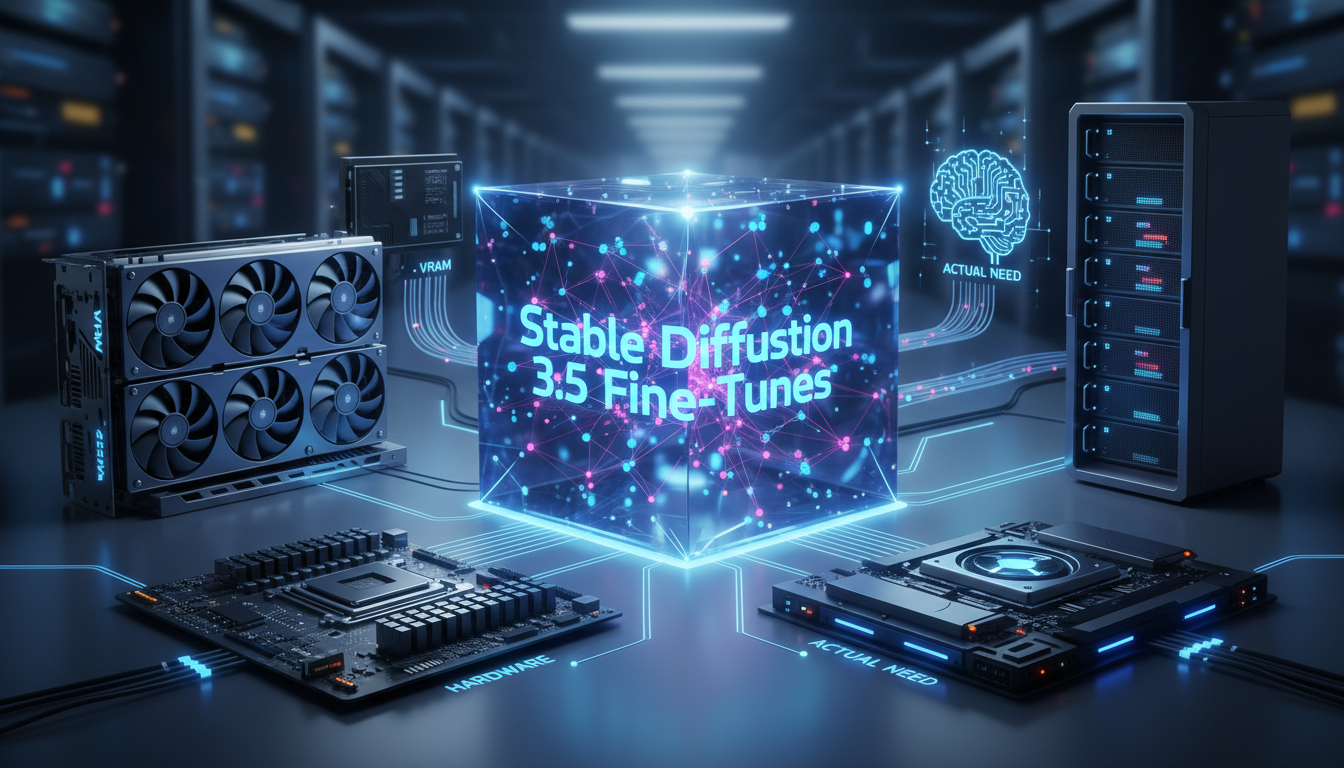
The base SD 3.5 Large checkpoint is roughly 6.5GB in fp16 format. That's just the UNet weights. On top of that, you need to load three text encoders, a VAE, and whatever sampling infrastructure your frontend uses. In practice, here's what you're looking at for total memory consumption during generation.
| GPU VRAM | What You Can Run | Experience Level |
|---|---|---|
| 6GB | fp8 quantized models, low resolution, single image | Usable but limited |
| 8GB | fp16 at 1024x1024, most fine-tunes work | Comfortable for casual use |
| 10-12GB | Full precision, higher resolutions, small batch sizes | Ideal for most creators |
| 16GB+ | Everything, including large batches and hires fix | No compromises |
| 24GB (4090) | Multiple models loaded, extensive tiling, controlnet stacks | Professional workflow |
I've been running most of my tests on an RTX 4090 with 24GB, so I can test everything without constraints. But I also keep an RTX 3060 12GB system specifically to verify that models work on mid-range hardware. If you're on 8GB of VRAM, you can run every model on this list, but you'll want to use fp16 or fp8 quantization and keep your resolution at or below 1024x1024.
One thing I've noticed is that some fine-tunes are more VRAM efficient than others despite having the same parameter count. ConceptForge 3.5, for example, consistently uses about 800MB less VRAM than IllustraForge during generation, even though they're both based on the same SD 3.5 Large architecture. The training process and any architecture modifications the creator makes can affect memory footprint.
If you don't want to deal with VRAM limitations at all, cloud-based platforms like Apatero.com let you run these models on high-end GPUs without owning one. That's particularly useful for trying out models before committing to downloading them locally.
VRAM usage comparison across tested fine-tunes at 1024x1024 resolution with fp16 precision. ConceptForge and MangaInk Pro are the most efficient.
Want to skip the complexity? Apatero gives you professional AI results instantly with no technical setup required.
How Do You Install and Use SD 3.5 Fine-Tunes?
Getting these models running locally is straightforward, but there are a few gotchas that catch people off guard. Let me walk through the process.
ComfyUI Setup
ComfyUI is my preferred way to run SD 3.5 fine-tunes because it gives you the most control over the generation pipeline. Here's what you need:
- Make sure you're running ComfyUI version 0.3.0 or newer (the SD 3.5 nodes were added in late 2025)
- Download your chosen fine-tune from CivitAI and place it in
ComfyUI/models/checkpoints/ - You'll also need the three text encoders: CLIP ViT-L, CLIP ViT-bigG, and T5-XXL. Place them in
ComfyUI/models/clip/ - Use the
CheckpointLoaderSimplenode or the dedicated SD3.5 loader node - Set your sampler to
eulerordpmpp_2mwith thesgm_uniformscheduler for best results
The T5-XXL encoder is the memory hog in this pipeline. It's about 9.5GB on its own in fp16. If you're tight on VRAM, you can use the fp8 quantized version of T5-XXL, which cuts it down to roughly 4.8GB with minimal quality loss. I've done extensive A/B testing between fp16 and fp8 T5, and honestly, I can only spot differences in about 10% of outputs, usually in complex multi-subject scenes.
# Recommended ComfyUI node setup for SD 3.5 fine-tunes
CheckpointLoaderSimple -> KSampler -> VAEDecode -> SaveImage

# KSampler settings that work well across most fine-tunes:
# Steps: 25-35
# CFG: 4.0-7.0 (lower than SDXL!)
# Sampler: euler or dpmpp_2m
# Scheduler: sgm_uniform
# Denoise: 1.0 (for txt2img)
A critical tip that trips up almost everyone coming from SDXL: SD 3.5 uses much lower CFG values. If you're used to running CFG 7-12 with SDXL, you need to dial it way back. Most SD 3.5 fine-tunes produce their best results between CFG 3.5 and 6.0. Go higher and you'll get the telltale over-saturated, contrasty look that screams "AI generated."
Forge/WebUI Setup
If you're using Forge (the maintained fork of Automatic1111), SD 3.5 support has been solid since version 1.9. Drop the checkpoint in the models folder, select it from the dropdown, and you're good to go. Forge handles the text encoder loading automatically.
I'd still recommend ComfyUI for serious work because the node-based approach gives you more flexibility with sampling, conditioning, and post-processing. But Forge is perfect for quick generation sessions where you just want to type a prompt and go.
What Prompt Strategies Work Best with SD 3.5 Fine-Tunes?
Prompting for SD 3.5 is genuinely different from SDXL, and I think a lot of people are getting suboptimal results because they haven't adjusted their approach. Here's what I've learned from six weeks of intensive testing.
First, natural language works better than keyword dumping. With SDXL, we all got used to prompting like "beautiful woman, detailed skin, masterpiece, best quality, 8k, ultra detailed." That tagging approach came from the Danbooru-trained models and it stuck around. SD 3.5's T5 encoder actually understands full sentences, so "a portrait photograph of a woman with freckles, natural lighting from a nearby window, shot on 85mm lens" will give you better results than keyword soup.
Second, negative prompts matter less. The base SD 3.5 model and most fine-tunes have been trained to produce good results without extensive negative prompting. Where SDXL needed a paragraph of negative prompts to avoid common artifacts, SD 3.5 usually just needs "low quality, blurry" or sometimes nothing at all. Some fine-tune creators specifically recommend empty negative prompts.
Third, and this is a personal observation from testing all these models, specifying artistic medium and lighting explicitly tends to have a bigger impact than it did with SDXL. Prompts that include "oil painting on canvas" or "photograph, overcast lighting, golden hour" or "digital illustration, cel-shaded, flat colors" push the output much more decisively toward those styles.
Here's a practical example. This prompt works beautifully across most of the fine-tunes I've tested:
A weathered fisherman mending nets on a wooden dock at dawn.
The harbor behind him is filled with small boats.
Morning fog rolling across the water, warm golden light
breaking through the mist. Shot from slightly below,
environmental portrait style.
That kind of descriptive, scene-setting prompt will outperform a keyword list every time on SD 3.5 fine-tunes.
Are SD 3.5 Fine-Tunes Better Than SDXL Models Now?
This is where I'm going to give you a hot take that I know will be controversial: for most use cases in 2026, yes, SD 3.5 fine-tunes have surpassed SDXL fine-tunes. And it's not just about raw image quality.
Earn Up To $1,250+/Month Creating Content
Join our exclusive creator affiliate program. Get paid per viral video based on performance. Create content in your style with full creative freedom.

The prompt adherence improvement is massive. SDXL was notorious for ignoring parts of complex prompts. Ask for "a cat wearing a red hat sitting on a blue chair" and you might get the cat and the chair but the hat would be blue too, or it'd be on the chair instead of the cat. SD 3.5's triple encoder architecture handles compositional prompts with dramatically better accuracy. When you specify colors, positions, counts, and relationships, the model actually follows your instructions.
Typography puts SD 3.5 in a different league entirely. If your workflow involves any kind of text rendering, mockups, poster designs, or logos with text, there's simply no comparison. SDXL can barely render a single word. SD 3.5 can render short phrases with reasonable accuracy, and some fine-tunes have pushed this even further.
The one area where SDXL still has advantages is ecosystem maturity. There are thousands of SDXL LoRAs, embeddings, and ControlNet models available. The SD 3.5 ecosystem is growing fast, but it's not as extensive yet. If you rely heavily on specific LoRAs for your workflow, check compatibility before switching. My best Stable Diffusion models guide covers the broader landscape if you're weighing your options.
That said, the momentum is clearly with SD 3.5. On Apatero.com, I've noticed that SD 3.5 based workflows are already outpacing SDXL workflows in usage, and the gap widens every month. The community is voting with their feet.
What Specialized Fine-Tunes Are Worth Knowing About?
Beyond the major categories, there are some niche fine-tunes that deserve attention for specific workflows.
ArchViz35
This is a purpose-built architectural visualization model. It produces interior and exterior renders that look like they came from a professional 3D rendering pipeline. If you're an architect, interior designer, or real estate professional, this model will save you hours compared to trying to coax architectural renders out of a general-purpose model.
I tested it against some Blender renders I'd done for a friend's renovation project, and the AI-generated versions were honestly more appealing. They had better staging, more natural lighting, and that aspirational quality that makes architectural visualization effective.
PixelCraft SD35
Pixel art has been notoriously difficult for diffusion models. They can approximate the look, but getting clean, grid-aligned pixels with proper dithering and limited color palettes is a different story. PixelCraft SD35 nails it. The outputs look like they were drawn pixel by pixel in Aseprite. Perfect for indie game developers who need concept art or asset prototyping.
SciViz Pro
Scientific and technical illustration is another niche where a dedicated fine-tune makes an enormous difference. SciViz Pro produces clean diagrams, anatomical illustrations, botanical drawings, and engineering schematics. The line work is precise, labels are readable (thanks to SD 3.5's text rendering), and the overall aesthetic matches what you'd find in a professional textbook.
How Do You Choose the Right Fine-Tune for Your Project?
With so many options available, picking the right model can feel overwhelming. Here's my practical framework for making the decision.
Start by identifying your primary use case. Are you generating photos that need to look real? Character designs for a creative project? Product mockups? Concept art for a game? Each category has a clear winner, and trying to use a photorealism model for anime or vice versa will always produce inferior results.
Next, consider your hardware constraints. If you're on 8GB of VRAM, the fp8-friendly models like MangaInk Pro and ConceptForge 3.5 will give you the best experience. If you've got a 4090 or you're running on cloud GPUs, you can use anything on this list without worrying about it.
Then think about your workflow. Do you need to stack LoRAs on top of the base checkpoint? IllustraForge and AnimeMasterV3 handle LoRA composition best. Do you need fast iteration? ConceptForge 3.5's low step count is your friend. Do you need text rendering? Stick with models that build on SD 3.5's native typography support rather than fighting against it.
Finally, download two or three candidates and run your own test prompts. My rankings reflect my testing methodology and preferences, but your specific prompts and aesthetic preferences might lead you to a different conclusion. The beauty of open-source models is that trying them costs nothing but bandwidth and time.
CivitAI's filtering system lets you narrow down SD 3.5 fine-tunes by base model, category, and sort by downloads or rating.
Frequently Asked Questions
Can I use SD 3.5 fine-tunes with my existing SDXL LoRAs?
No. SD 3.5 uses a completely different architecture (MMDiT) compared to SDXL's UNet. LoRAs trained for SDXL are incompatible with SD 3.5 checkpoints. You'll need SD 3.5 specific LoRAs, and the selection is growing rapidly on CivitAI and HuggingFace.
How much disk space do SD 3.5 fine-tunes require?
A typical SD 3.5 Large fine-tune is approximately 6.5-7GB in fp16 safetensors format. You'll also need the text encoders (approximately 15GB combined for all three in fp16) and the VAE (about 300MB). Plan for roughly 25GB total for a complete setup with one checkpoint.
Do SD 3.5 fine-tunes support ControlNet?
Yes, but the ControlNet ecosystem for SD 3.5 is still developing. As of March 2026, there are working ControlNet models for Canny, Depth, and OpenPose. The community is actively training more. If you rely heavily on ControlNet for your workflow, check that the specific control types you need are available.
What's the difference between SD 3.5 Large and SD 3.5 Medium for fine-tuning?
SD 3.5 Large has 2 billion parameters and uses three text encoders. SD 3.5 Medium has about 800 million parameters and uses two text encoders (dropping T5-XXL). Large produces significantly better results, especially for complex prompts, but Medium runs on lower VRAM systems. Most high-quality community fine-tunes are based on Large because the quality difference is substantial.
Can I merge SD 3.5 fine-tunes together like SDXL checkpoints?
Model merging works with SD 3.5, but it's trickier than with SDXL. The MMDiT architecture means that naive weight averaging can produce worse results than either parent model. Some community tools have been updated to support weighted merging with SD 3.5, but I'd recommend using established merged models rather than trying to create your own unless you know what you're doing.
Are these fine-tunes safe to use commercially?
SD 3.5 was released under the Stability AI Community License, which allows commercial use with some restrictions (notably, a revenue threshold). Most community fine-tunes inherit this license, but some creators apply additional restrictions. Always check the license on the specific model's CivitAI or HuggingFace page before using outputs commercially.
Why do my SD 3.5 fine-tune outputs look over-saturated?
You're almost certainly using too high a CFG value. This is the number one mistake people make when switching from SDXL. Lower your CFG to 3.5-6.0 range. Also make sure you're using the sgm_uniform scheduler, as other schedulers can produce color artifacts with SD 3.5 architecture.
How do I know if a CivitAI checkpoint is actually a good fine-tune versus a low-effort merge?
Look for models with detailed training documentation, before/after comparisons, and high ratings with substantial review counts. Models with just a few sample images and no training details are often quick merges that don't offer meaningful improvements. The models I've listed in this guide all have transparent training methodologies and consistent community feedback.
Can I run these models on Mac with Apple Silicon?
Yes, but with caveats. ComfyUI and Forge both support Apple Silicon through MPS, and most SD 3.5 fine-tunes work correctly. Performance is significantly slower than equivalent NVIDIA GPUs. An M2 Max with 32GB unified memory can generate 1024x1024 images in roughly 30-45 seconds, compared to 5-7 seconds on an RTX 4090. The unified memory architecture means you won't hit VRAM limits as easily, though.
What's coming next for SD 3.5 fine-tunes?
The community is currently working on several exciting developments. Turbo/distilled versions of popular fine-tunes that can produce good results in 4-8 steps are in active development. IP-Adapter support for SD 3.5 is being worked on by multiple teams. And there's growing interest in training LoRAs using the DreamBooth vs LoRA approaches specifically optimized for the MMDiT architecture. Expect the ecosystem to look very different by mid-2026.
Final Thoughts
The SD 3.5 fine-tune ecosystem in 2026 is the most exciting thing happening in open-source AI image generation. The combination of a powerful base architecture, an active community, and increasingly sophisticated training techniques has produced models that genuinely rival commercial APIs in output quality, while remaining completely free and open.
If you're still running SDXL exclusively, I'd strongly encourage you to try at least one or two of the fine-tunes I've recommended here. The prompt adherence improvements alone make the switch worthwhile, and the typography support opens up entirely new creative possibilities.
For my money, RealVision 3.5 XL, AnimeMasterV3, and IllustraForge represent the current peak of community model development. But this space moves incredibly fast, and I'll be updating this ranking as new contenders emerge. If you want to stay on top of the latest developments, keep an eye on Apatero.com where I regularly feature new models and workflows as they drop.
The democratization of high-quality AI image generation continues, and it's the community fine-tune creators who are driving it forward. Download a model, fire up ComfyUI, and start generating. You might be surprised at just how good these models have become.
Some models you cannot download at any VRAM
Veo, Kling and Nano Banana have closed weights. There is no local build, no quantization, no 24GB workaround. Run them in the browser instead. First generation free.
Related Articles

10 Best AI Influencer Generator Tools Compared (2025)
Comprehensive comparison of the top AI influencer generator tools in 2025. Features, pricing, quality, and best use cases for each platform reviewed.
5 Proven AI Influencer Niches That Actually Make Money in 2025
Discover the most profitable niches for AI influencers in 2025. Real data on monetization potential, audience engagement, and growth strategies for virtual content creators.
AI Action Figure Generator: How to Create Your Own Viral Toy Box Portrait in 2026
Complete guide to the AI action figure generator trend. Learn how to turn yourself into a collectible figure in blister pack packaging using ChatGPT, Flux, and more.