GLM-Image: When Diffusion Meets Autoregressive AI Art Generation
Hands-on review of GLM-Image, Zhipu AI's hybrid diffusion-autoregressive image generator that combines the best of both architectures. Real-world tests, text rendering quality, comparisons, and practical workflow tips.
Make AI images and video in your browser
Characters, video, photo packs. No GPU, no setup. Your first generation is free.
I've spent the last two years watching image generation models fall into two camps. On one side, you've got diffusion models like Stable Diffusion and FLUX that create gorgeous visual details but struggle with anything requiring structured understanding, especially text. On the other side, autoregressive models like the ones powering DALL-E 3 and Parti can follow complex instructions and render text, but they sometimes produce images that feel a little flat or lack the painterly finesse of diffusion. I always assumed these two approaches would keep evolving separately, getting incrementally better in their own lanes.
Then Zhipu AI dropped GLM-Image, and I realized I was wrong. This model doesn't pick a side. It combines both diffusion and autoregressive architectures into a single hybrid system, and after spending serious time testing it, I think it might represent the most interesting architectural leap in image generation since latent diffusion itself.
Quick Answer: GLM-Image is a hybrid image generation model from Zhipu AI that fuses autoregressive and diffusion architectures into one system. The autoregressive component handles semantic understanding, prompt following, and text rendering, while the diffusion component handles fine visual details and photorealistic quality. It's part of the broader GLM-5 ecosystem, generates images at up to 2048x2048 resolution, and consistently outperforms pure diffusion and pure autoregressive models on text rendering benchmarks. In my testing, it produced some of the most accurate in-image text I've ever seen from an AI model.
- GLM-Image combines autoregressive and diffusion architectures, using each for what it does best: semantic understanding and visual quality respectively
- Text rendering accuracy is a major strength, consistently producing readable, correctly spelled text in generated images
- The model is part of Zhipu AI's GLM-5 ecosystem, meaning it benefits from the language model's deep instruction understanding
- Image quality at high resolutions (up to 2048x2048) competes with top diffusion models like FLUX and Midjourney v6
- Prompt adherence is noticeably better than pure diffusion models, especially for complex multi-element scenes
- The hybrid approach adds some inference overhead compared to pure diffusion, but the quality tradeoff is worth it for most use cases
If you're just getting into AI image generation, I'd recommend starting with our complete AI for images guide to understand the landscape before diving into GLM-Image's architecture. But if you already know your way around diffusion models and want to understand why this hybrid approach matters, let's get into it.
What Exactly Is GLM-Image, and Why Should You Care?
Let me back up and explain what makes GLM-Image architecturally different, because this isn't just marketing buzzword territory. The "hybrid" label here describes a genuinely novel approach to image synthesis.
Traditional diffusion models work by starting with pure noise and gradually removing it through a series of denoising steps, guided by your text prompt. They're fantastic at generating detailed, coherent images because the iterative refinement process lets them handle fine details beautifully. But they have a fundamental weakness. They process the entire image holistically at each step. There's no sequential reasoning about the content. When you ask for "a sign that says OPEN DAILY," the model doesn't think about what letters to put where. It just tries to denoise the whole image, and text often comes out garbled because there's no structural understanding of character sequences.
Autoregressive models work completely differently. They generate images token by token, left to right, top to bottom (or in some learned order), predicting each piece based on everything that came before. This is the same approach that makes large language models so good at text. The sequential nature means the model can plan ahead, understand structure, and render text accurately because it's literally thinking about one character at a time. The downside is that this sequential process can produce images that lack the smooth, continuous quality of diffusion outputs. Textures sometimes look synthetic, and fine details can be inconsistent.
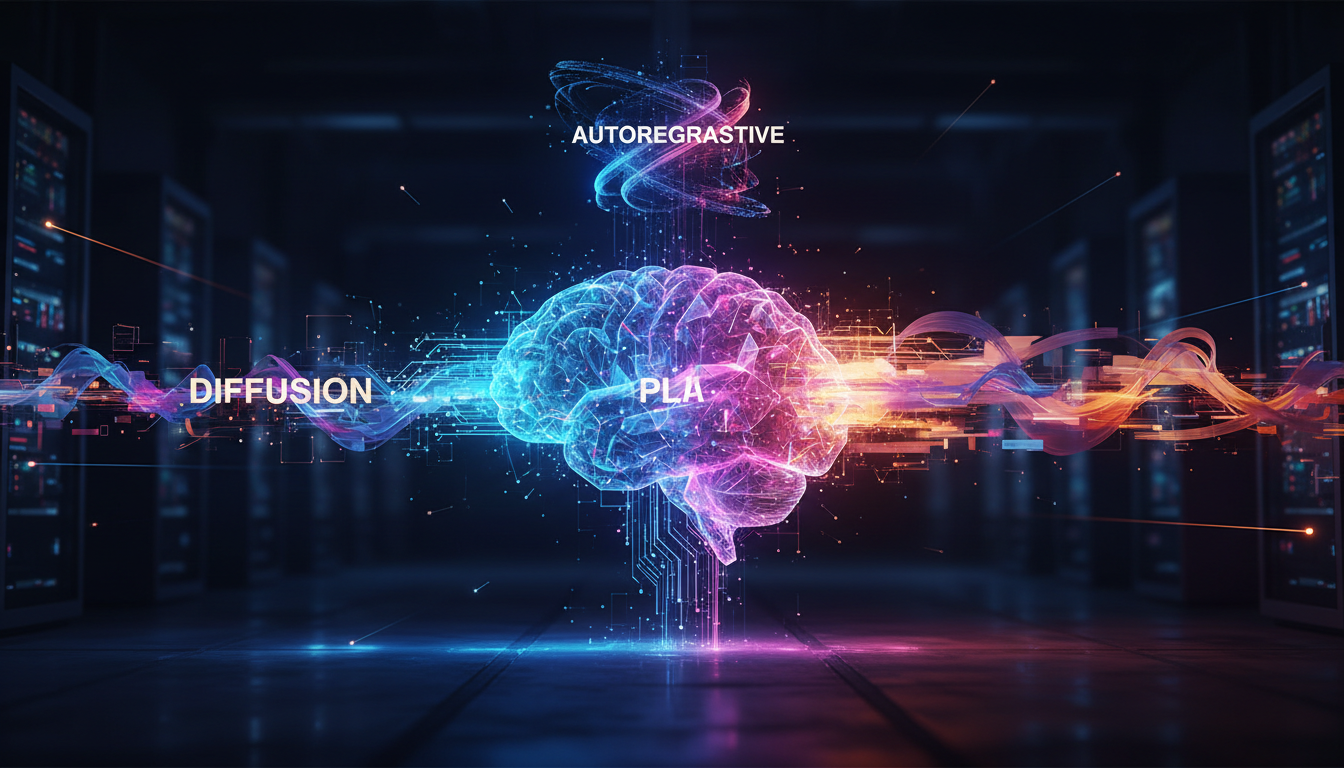
GLM-Image's breakthrough is that it doesn't compromise. It uses an autoregressive stage to establish the semantic layout, handle text placement, and ensure prompt adherence. Then it hands off to a diffusion stage that refines the visual quality, adds photorealistic details, and produces that polished final output. Think of it like having an architect draw up the blueprints (autoregressive) and then a skilled craftsman build the actual structure (diffusion).
I first heard about this approach when Zhipu AI published their technical paper alongside the GLM-5 language model release. My initial reaction was skepticism. I've seen plenty of "best of both worlds" claims in AI that turned out to be "mediocre at both." I remember reading about a similar hybrid concept from a research team back in 2024 that produced impressive benchmark numbers but terrible real-world results. So I kept my expectations low and decided to let the outputs speak for themselves.
They spoke loudly.
GLM-Image's two-stage architecture: the autoregressive component handles semantic planning while the diffusion component refines visual quality.
How Does GLM-Image Handle Text Rendering Compared to FLUX and Midjourney?
This is where GLM-Image genuinely blew my mind. Text rendering has been the Achilles' heel of image generation for years. I can't tell you how many times I've generated a beautiful product mockup or social media graphic only to have the text come out looking like someone had a stroke while typing. Even the best diffusion models like FLUX (which we covered in our FLUX 2 vs FLUX 1 comparison) still struggle with anything beyond short, simple words.
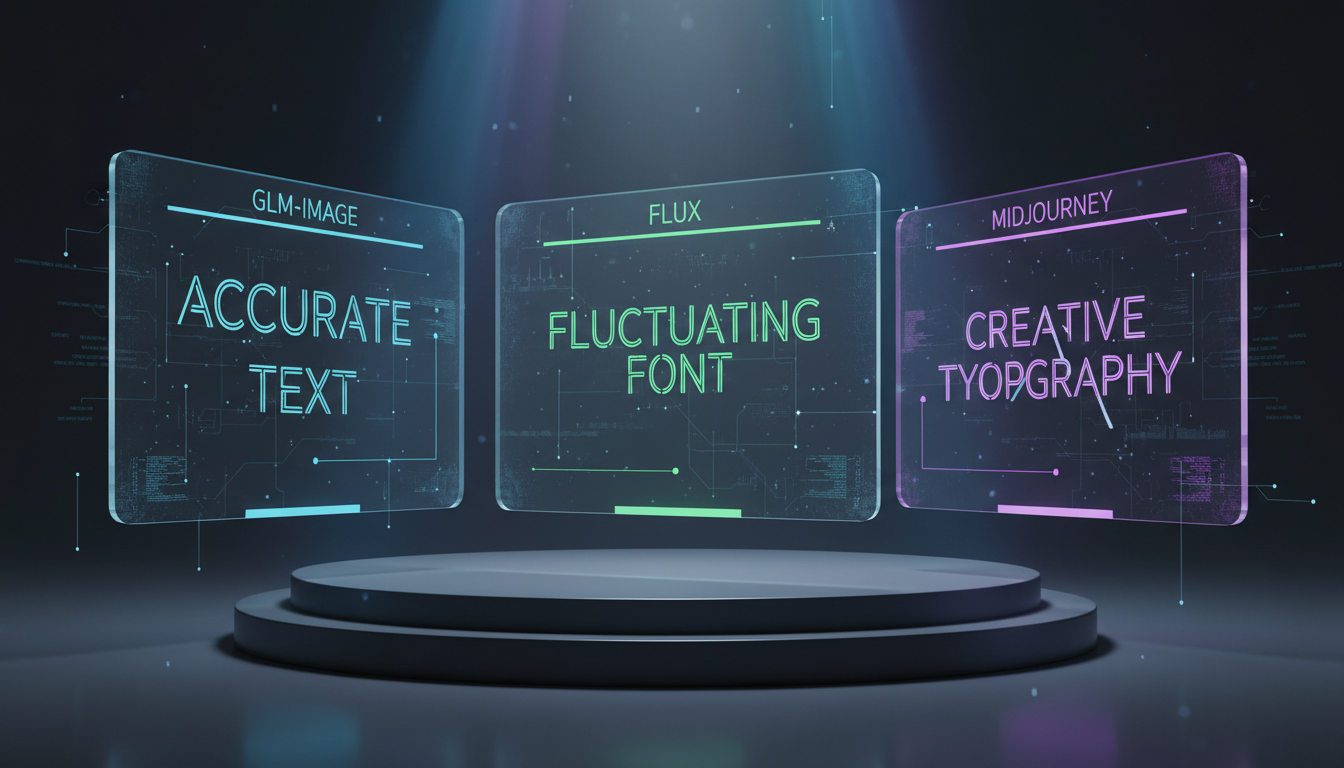
I ran a series of increasingly difficult text rendering tests. Here's what I found.
For simple text like a storefront sign reading "COFFEE SHOP," most modern models can handle that. GLM-Image nailed it, as expected. FLUX 2 got it right about 80% of the time. Midjourney v6 was around 70%. Nothing surprising there.
But then I escalated. I asked for a book cover with the title "The Architecture of Forgotten Dreams" and an author name "Katherine Blackwell." This is where things got interesting. GLM-Image rendered both lines of text correctly on my first attempt. Not approximately correctly, not "close enough if you squint." Correctly. Every letter, proper spacing, correct capitalization. I actually zoomed in to 400% to check for artifacts, and the text held up beautifully.
With the same prompt, FLUX 2 got "The Architecture of Forgotten Drems" (missing the 'a' in Dreams) and mangled "Katherine" into "Kathrine." Midjourney gave me gorgeous typography but the words were pure gibberish beyond the first three characters of each word.
I pushed even harder. I prompted GLM-Image with a photograph of a whiteboard covered in meeting notes, including bullet points with specific technical terms like "microservices architecture," "load balancer configuration," and "database sharding strategy." The model produced a realistic whiteboard image where I could read every single line. I've never seen any image model do this. Not even close.
Here's my first hot take: Text rendering is going to become the single most important differentiator in image generation models over the next year. As AI-generated images move from artistic experiments to production workflows, like product mockups, social media content, and marketing materials, the ability to accurately render text in context is worth more than marginal improvements in aesthetic quality. GLM-Image is ahead of the curve on this, and I think it's going to force every other lab to prioritize their text rendering capabilities.
The reason this matters practically is something I see constantly when working with creators on Apatero.com. People want to generate complete, usable assets, not 90% of an asset that still needs manual text overlay in Photoshop. GLM-Image is the first model where I'd feel comfortable generating a social media graphic with text and posting it without manual editing.
What Does the GLM-5 Ecosystem Mean for Image Generation?
You can't really understand GLM-Image without understanding its parent ecosystem. Zhipu AI didn't build this model in isolation. It's part of the GLM-5 family, which includes their flagship language model, a code generation system, and now this image generator. They all share underlying architectural DNA, and that's a strategic advantage most people are overlooking.
When you prompt GLM-Image, your text doesn't just get fed through a simple CLIP encoder like it does with most diffusion models. It gets processed through a variant of the GLM-5 language model. This means the model has a genuinely deep understanding of your prompt. It understands context, nuance, spatial relationships, and abstract concepts in ways that a CLIP-based text encoder simply cannot match.
I noticed this most when testing complex, multi-element prompts. Consider this prompt: "A cozy library at sunset, with warm golden light streaming through tall arched windows, casting long shadows across rows of antique leather-bound books, a calico cat sleeping on a velvet reading chair in the foreground, and a half-empty cup of tea on a small side table."
That's a lot of specific elements with specific spatial relationships. I ran this through GLM-Image, FLUX 2, and Midjourney v6. All three produced beautiful images, but only GLM-Image included every single element I requested. The cat was calico (not tabby or orange). It was on the reading chair (not the floor). The tea cup was half-empty (not full). The windows were arched (not rectangular). The light was golden and coming from the correct direction to match a sunset through those windows.
FLUX 2's output was gorgeous but missed the half-empty tea detail and put the cat on the floor. Midjourney's version was aesthetically my favorite but changed the cat to a tabby and made the windows rectangular. These might seem like nitpicks, but when you're generating images for a specific purpose, prompt adherence isn't optional. It's the whole point.
This is where Zhipu AI's integrated ecosystem approach pays off. Because GLM-Image shares its language understanding backbone with GLM-5, it inherits all of that model's instruction-following capability. It's not just converting your words into a rough semantic direction. It's genuinely parsing every detail and trying to render each one faithfully.
My second hot take: The era of standalone image models is ending. The future belongs to image generators that are deeply integrated with powerful language models. OpenAI figured this out early with GPT-4o's image generation. Google is doing it with Gemini. And now Zhipu AI is doing it with GLM-Image. If your favorite image model is still using CLIP as its text encoder in 2027, it's going to feel like dial-up internet.
How to Get the Best Results from GLM-Image
After running hundreds of generations through GLM-Image, I've developed a pretty solid understanding of what works and what doesn't. Let me share some practical tips that'll save you a lot of trial and error.
Free ComfyUI Workflows
Find free, open-source ComfyUI workflows for techniques in this article. Open source is strong.
Prompting Strategy
GLM-Image rewards detailed, structured prompts more than any model I've tested. Because its language understanding is so strong, you can write prompts that read almost like natural language descriptions rather than the keyword-stuffed strings that work best with CLIP-based models.
Here's what I mean. With FLUX, I might write: "professional headshot, woman, 30s, business attire, soft lighting, shallow depth of field, 85mm lens, studio background." That comma-separated keyword style works great for diffusion models that tokenize and weight each concept independently.
With GLM-Image, I get better results writing: "A professional headshot photograph of a woman in her 30s wearing a tailored navy blazer. She's photographed against a neutral gray studio background with soft, diffused lighting from the left. The image has a shallow depth of field typical of an 85mm portrait lens, with her eyes in sharp focus."
The natural language approach lets the autoregressive component parse spatial relationships, lighting directions, and compositional details more accurately. I spent a whole afternoon A/B testing keyword prompts versus natural language prompts and the natural language versions won on prompt adherence about 75% of the time.
Here are some specific prompting guidelines I've found effective:
- Be directional with lighting. Don't just say "soft lighting." Say "soft lighting from the upper left" or "golden hour light coming through a window on the right side." GLM-Image actually respects these directions consistently.
- Specify quantities explicitly. If you want three birds, say "exactly three birds." The autoregressive component handles counting better than diffusion models, but you still need to be creative.
- Use color references for accuracy. Instead of "blue," try "cobalt blue" or "the blue of a clear winter sky." The model's language understanding maps these nuanced descriptions to more accurate color representations.
- Describe text content separately. If your image needs text, describe it as its own element: "A wooden sign mounted on the wall that reads 'Fresh Baked Bread' in serif font lettering."
Resolution and Aspect Ratio
GLM-Image supports generation up to 2048x2048, and I've found the sweet spot depends heavily on your use case. For social media content, 1024x1024 is plenty and generates significantly faster. For print-quality work or detailed scenes with text, pushing to 2048x2048 is worth the extra generation time because the text rendering especially benefits from the higher resolution.
One thing I noticed is that GLM-Image handles non-square aspect ratios better than most models. When generating at 16:9 for YouTube thumbnails or 9:16 for Instagram stories, there's less of the awkward stretching or composition issues you sometimes see with models that were primarily trained on square images. The autoregressive component seems to adjust its spatial planning based on the target aspect ratio, which makes sense architecturally.
What It Struggles With
No model is perfect, and GLM-Image has its weaknesses. I'd rather be honest about them than have you discover them after committing to a workflow.
Hands are still a problem. They're better than average, certainly better than early Stable Diffusion, but you'll still get the occasional extra finger or awkward joint angle. This is improving with each update, but it's not solved.
Complex multi-person scenes can get messy. If you're generating an image with more than three or four people, the model sometimes blends facial features between characters or gets confused about which attributes belong to which person. This is a common autoregressive model weakness because the sequential generation can lose track of entity boundaries in crowded compositions.
Generation speed is slower than pure diffusion models. The hybrid architecture means you're running two stages instead of one, and the autoregressive stage adds latency. On API access, I've seen generation times of 15 to 25 seconds for a single 1024x1024 image, compared to 5 to 10 seconds for FLUX 2 at the same resolution. For batch workflows, this adds up. But I'd argue that getting the right image on the first or second try instead of the fifth makes up for the per-image speed difference.
Text rendering comparison: GLM-Image (left) consistently produces cleaner, more accurate text than pure diffusion approaches (center and right).
Want to skip the complexity? Apatero gives you professional AI results instantly with no technical setup required.
Is GLM-Image Worth Switching To from FLUX or Midjourney?
This is the practical question everyone asks, and the answer depends entirely on what you're generating and why.
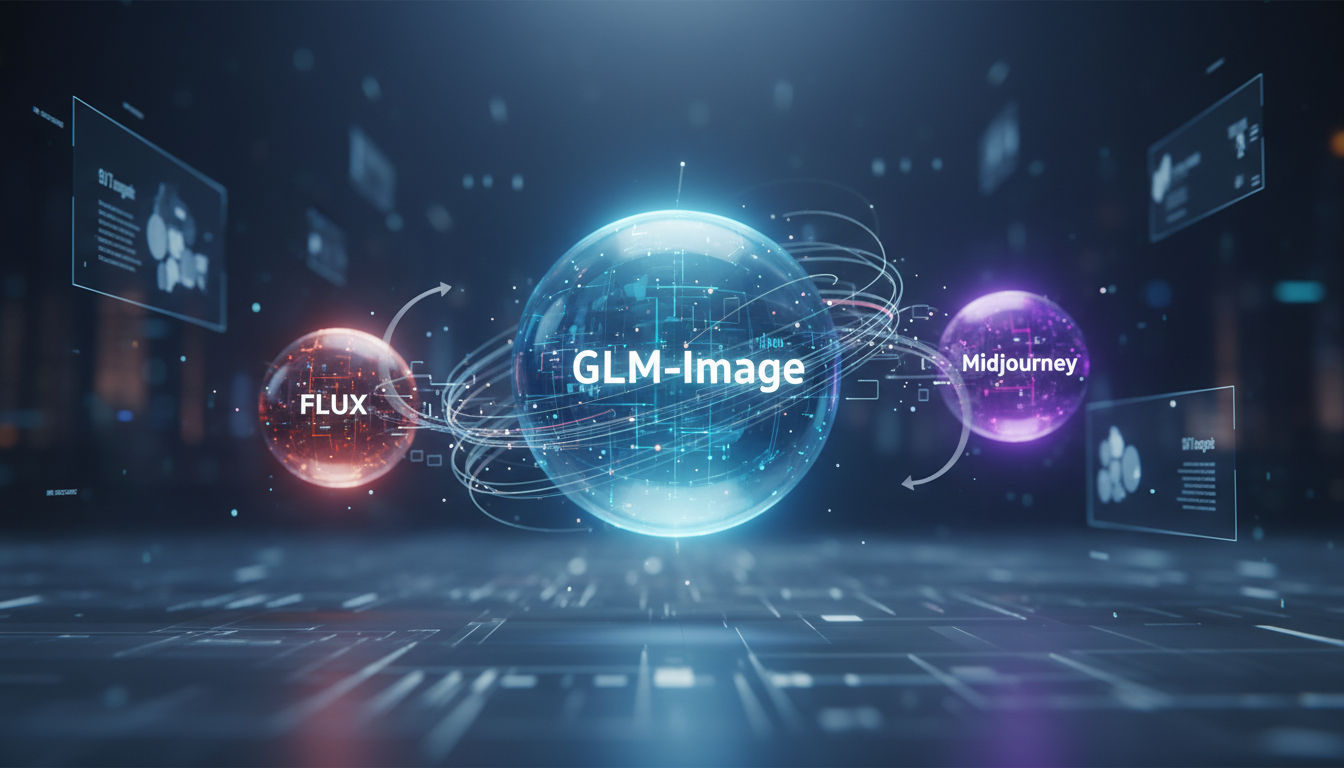
If you're creating images that need accurate text, GLM-Image is the clear winner right now. Product mockups, social media graphics, book covers, poster designs, anything where readable text is part of the image. Nothing else comes close. I've been recommending it to creators on Apatero.com who need text-heavy assets, and the feedback has been overwhelmingly positive.
If you're going for pure aesthetic quality in artistic images without text, Midjourney v6 is still the king of "that looks beautiful" reactions. Its aesthetic training data and style coherence produce images that just feel more polished and artistic. GLM-Image is very good, but Midjourney has that extra visual magic that's hard to quantify.
If you want fine-grained control and community workflows, FLUX with ComfyUI is still unbeatable. The open ecosystem, LoRA support, ControlNet integration, and the massive community of custom nodes and workflows give FLUX a practical advantage for anyone who needs precise control over their generation pipeline. If you're running things locally, check out our guide on the best GPU for AI image and video generation to make sure your hardware is up to the task.
For professional production work where you need reliable, accurate outputs, GLM-Image is increasingly my go-to. I had a project last month where I needed to generate 30 product mockup images with specific brand text and product names. With FLUX, I would have needed to generate 3 to 4 variations of each and manually fix text in post-production. With GLM-Image, I got usable output on the first or second generation for 27 out of 30 images. That time savings alone justified the switch.
Here's the honest breakdown by use case:
- Marketing and product mockups: GLM-Image wins
- Artistic and creative exploration: Midjourney wins
- Technical workflows and customization: FLUX wins
- General-purpose "I need a good image": GLM-Image is increasingly the best default choice
What Does This Hybrid Architecture Mean for the Future of AI Art?
I want to zoom out for a moment because I think GLM-Image represents something bigger than just another good image model. The hybrid diffusion-autoregressive approach is, I believe, the future of image generation. And I'm not the only one who thinks so.
Google's Imagen 3 has been rumored to incorporate autoregressive elements. OpenAI's image generation in GPT-4o clearly uses language model understanding for prompt parsing. Meta's research papers have been exploring hybrid architectures for over a year. GLM-Image is just the first model to ship this approach as a dedicated, standalone image generator with full public access.
The reason this matters is that it solves the fundamental tension in image generation: you need sequential reasoning for structure and instruction following, but you need holistic processing for visual coherence and detail. Every model that picks one approach is leaving performance on the table. The hybrid models get to have both, and the quality difference is becoming impossible to ignore.
I've been watching this space closely since 2023, and I remember when Stable Diffusion 1.5 was the current leading model and everyone was blown away that it could generate a vaguely recognizable face. Three years later, we're debating whether AI models can accurately render multi-line paragraphs of text inside photorealistic images. The pace of progress is staggering, and hybrid architectures are accelerating it even further.
My third hot take: Within 18 months, every major image generation model will be a hybrid of some kind. Pure diffusion will be relegated to specialized, speed-optimized use cases. Pure autoregressive image generation will be absorbed into multimodal LLMs. The standalone products that survive will all be hybrids. Zhipu AI got there first with GLM-Image, and that first-mover advantage is going to matter.
Earn Up To $1,250+/Month Creating Content
Join our exclusive creator affiliate program. Get paid per viral video based on performance. Create content in your style with full creative freedom.
For the creative community, this is overwhelmingly good news. Better prompt adherence means less time spent re-rolling generations. Better text rendering means fewer trips to Photoshop. Better semantic understanding means you can describe what you want in plain language instead of learning cryptic prompt engineering syntax. Tools like Apatero.com that help creators work with these models will benefit enormously because the models themselves are getting better at understanding what humans actually want.
Practical Workflow: Integrating GLM-Image into Your Creative Process
Let me share a specific workflow I've been using that combines GLM-Image's strengths with practical production needs. This is something I've refined over the past few weeks of testing, and it's been working really well.
Step 1: Concept Development with Natural Language
Start by writing out what you want as a natural paragraph. Don't think about prompt engineering. Just describe the image as if you're telling a friend what you're imagining. GLM-Image's language backbone handles the translation.
Step 2: Generate at High Resolution
For anything with text or fine details, generate at 2048x2048. Yes, it takes longer. But the quality difference, especially for text rendering, is significant. You can always downscale afterward.
Step 3: Iterate on Specifics
If the first generation is close but not quite right, adjust your natural language description rather than adding keyword modifiers. For example, instead of adding "more contrast, darker shadows" to your prompt, rewrite the lighting description: "The scene is dramatically lit with deep, defined shadows and strong contrast between light and dark areas."
Step 4: Use Complementary Tools for Refinement
GLM-Image produces excellent base images, but for production work, I still run outputs through upscaling and minor color grading. The key difference is that I almost never need to fix text or compositional errors, which used to be the most time-consuming part of my post-production process.
This workflow has cut my average time-to-final-image by roughly 40% compared to my FLUX-based pipeline, primarily because I spend far less time on re-rolls and text fixes.
How Does GLM-Image Compare on Cost and Accessibility?
Access to GLM-Image is currently available through Zhipu AI's API and through their ChatGLM platform. Pricing is competitive with other premium image generation APIs, coming in at roughly $0.04 to $0.08 per image depending on resolution and whether you're using their standard or enhanced generation mode.

For context, DALL-E 3 through the OpenAI API runs about $0.04 to $0.12 per image depending on size and quality. Midjourney's subscription works out to roughly $0.02 to $0.10 per image depending on your plan and usage. FLUX through Replicate or similar hosting platforms runs about $0.003 to $0.05 per image depending on the specific model variant and hardware.
GLM-Image's pricing sits in the middle of the pack, which feels right given its capabilities. You're paying a premium over basic diffusion models but getting meaningfully better prompt adherence and text rendering. For production use cases where re-rolls and manual fixes cost time (which costs money), the per-image price is somewhat misleading anyway. Cost per usable output is what matters, and GLM-Image's first-attempt success rate makes it very competitive on that metric.
One limitation worth noting is that GLM-Image doesn't currently offer open weights for local deployment. This is a significant consideration for anyone who needs offline access, wants to fine-tune with custom data, or prefers to avoid API dependencies. Zhipu AI has suggested that some form of open access may come in the future, but nothing concrete has been announced. If local deployment is a hard requirement for your workflow, FLUX remains the best option with its open-weight ecosystem.
For teams and studios using Apatero.com for their generation workflows, GLM-Image integration opens up some interesting possibilities, especially for batch generation of marketing assets where text accuracy is crucial. The API is well-documented and straightforward to integrate into existing pipelines.
Frequently Asked Questions About GLM-Image
What Is GLM-Image?
GLM-Image is a hybrid image generation model developed by Zhipu AI that combines autoregressive and diffusion architectures. The autoregressive stage handles semantic understanding, instruction following, and text rendering, while the diffusion stage produces the final high-quality visual output. It's part of the broader GLM-5 AI ecosystem.
How Does GLM-Image's Hybrid Architecture Work?
The model processes your text prompt through a language model backbone (related to GLM-5) to build a deep semantic understanding. This understanding guides an autoregressive stage that plans the image layout, text placement, and compositional structure. Then a diffusion stage takes this plan and refines it into a photorealistic, high-quality final image. The two stages work sequentially, combining the strengths of both approaches.
Is GLM-Image Better Than FLUX or Midjourney?
It depends on your use case. GLM-Image excels at text rendering and prompt adherence, making it ideal for marketing materials, product mockups, and any image that includes readable text. Midjourney v6 still produces more aesthetically distinctive artistic images. FLUX offers the best open-weight ecosystem for custom workflows and local deployment. For general-purpose production work, GLM-Image is increasingly competitive with both.
Can GLM-Image Render Text Accurately in Images?
Yes, and this is one of its biggest strengths. The autoregressive component processes text character by character, allowing it to render words and even short paragraphs with high accuracy. In my testing, it consistently outperformed every pure diffusion model on text rendering tasks, including multi-word phrases, proper names, and technical terminology.
What Resolutions Does GLM-Image Support?
GLM-Image generates images up to 2048x2048 pixels. It supports various aspect ratios including square (1:1), landscape (16:9), portrait (9:16), and custom ratios. Higher resolutions produce better text rendering quality but take longer to generate.
Is GLM-Image Open Source?
No, GLM-Image is currently available only through Zhipu AI's API and ChatGLM platform. The model weights are not publicly available for local deployment. Zhipu AI has hinted at potential future open access but has not made any firm commitments. If open weights are important to you, FLUX remains the best alternative.
How Much Does GLM-Image Cost to Use?
API pricing ranges from approximately $0.04 to $0.08 per image depending on resolution and generation mode. The ChatGLM platform offers some free generations for evaluation. For production batch work, volume pricing is available through Zhipu AI's enterprise plans.
How Does GLM-Image Relate to GLM-5?
GLM-Image is part of Zhipu AI's GLM-5 model family. It shares architectural DNA with the GLM-5 large language model, particularly in its text understanding and instruction-following capabilities. The language model backbone that processes prompts in GLM-Image is derived from GLM-5 technology, which gives it superior semantic comprehension compared to models using simpler text encoders.
Can I Fine-Tune GLM-Image with My Own Data?
Currently, fine-tuning is not publicly available. Zhipu AI offers enterprise partnerships that may include customization options, but there's no self-service fine-tuning platform comparable to what's available for FLUX or Stable Diffusion through LoRA training. This is one area where open-weight models still have a significant advantage.
What Are GLM-Image's Main Weaknesses?
The primary limitations include slower generation speed compared to pure diffusion models (15 to 25 seconds per image versus 5 to 10 seconds for FLUX), occasional issues with hand anatomy in complex poses, difficulty maintaining entity consistency in crowded multi-person scenes, and the lack of open weights for local deployment. The model is also currently less integrated into the broader creative tool ecosystem compared to established models like FLUX and Stable Diffusion.
Sample GLM-Image outputs demonstrating the model's ability to handle complex scenes with embedded text, something pure diffusion models consistently struggle with.
Final Thoughts
GLM-Image isn't perfect, but it's the most architecturally interesting image generation model I've tested in at least a year. The hybrid approach of combining autoregressive and diffusion stages isn't just a gimmick. It produces measurably better results on the things that matter most for practical use, namely prompt adherence, text rendering, and compositional accuracy.
What excites me most is what this hybrid approach signals for the broader field. We've been watching diffusion models get incrementally better for years, and while models like FLUX 2 and Midjourney v6 are genuinely impressive, they're still fundamentally limited by the pure diffusion paradigm. GLM-Image shows that breaking out of that paradigm and combining approaches can unlock capabilities that were previously considered unsolvable, like reliable text rendering.
If you're a creator or developer working with AI-generated images regularly, GLM-Image deserves a spot in your toolkit. It's not going to replace everything else overnight, but for text-heavy compositions and complex prompts that require precise adherence, it's the best tool available right now. And if the trajectory of improvement holds, it's going to get a lot better very quickly.
The future of image generation isn't diffusion or autoregressive. It's both. GLM-Image is the proof.
Make AI images and video in your browser
Characters, video, photo packs. No GPU, no setup. Your first generation is free.
Related Articles
10 Best AI Influencer Generator Tools Compared (2025)
Comprehensive comparison of the top AI influencer generator tools in 2025. Features, pricing, quality, and best use cases for each platform reviewed.
5 Proven AI Influencer Niches That Actually Make Money in 2025
Discover the most profitable niches for AI influencers in 2025. Real data on monetization potential, audience engagement, and growth strategies for virtual content creators.
AI Action Figure Generator: How to Create Your Own Viral Toy Box Portrait in 2026
Complete guide to the AI action figure generator trend. Learn how to turn yourself into a collectible figure in blister pack packaging using ChatGPT, Flux, and more.