AI Influencer Voice and Tone: Developing Authentic Communication Style
Create a distinctive voice for your AI influencer. Learn how to develop consistent communication style, write in character, and build authentic personality through content.

Images capture attention; voice creates connection. Your AI influencer's appearance might make someone stop scrolling, but their voice determines whether followers feel genuine connection. Voice is how your character communicates, what they say and how they say it, the personality that comes through in every caption, story, and response.
The challenge for AI influencer creators is maintaining consistent voice across all communication. Unlike managing your own social media where voice comes naturally, an AI character requires intentional voice construction and disciplined maintenance. Every caption must sound like the same person.
I struggled with voice consistency early on. Some captions were casual and playful; others were formal and distant. Followers couldn't get a sense of who my character was beyond the images. When I developed a clear voice framework, engagement transformed. People felt like they knew her.
Quick Answer: Define your AI influencer's voice through personality traits, communication style preferences, vocabulary choices, and emotional range. Document this voice guide and reference it for all content. Voice should match character positioning and target audience expectations. Maintain consistency while allowing natural variation in tone based on content type.
:::tip[Key Takeaways]
- AI Influencer Voice and Tone: Developing Authentic Communication Style represents an important development in its field
- Multiple approaches exist depending on your goals
- Staying informed helps you make better decisions
- Hands-on experience is the best way to learn :::
- Components of brand voice for AI influencers
- Developing your character's personality expression
- Writing captions that maintain voice
- Voice consistency across content types
- Evolving voice authentically over time
Understanding Brand Voice
Voice encompasses every aspect of how your character communicates.
Voice Components
Personality: The underlying character traits that inform communication. Optimistic, thoughtful, playful, serious, caring, edgy, etc.
Tone: The emotional quality of specific communications. Excited, calm, supportive, sarcastic, vulnerable, confident, etc.
Style: The way messages are constructed. Formal vs casual, long-form vs brief, question-heavy vs statement-based.
Vocabulary: The specific words and phrases used. Technical language, slang, catchphrases, word choices that become signature.
Voice vs Tone Distinction
Voice is consistent. It's who your character is at their core. Tone varies based on context while staying within voice parameters.
Example: A character with an optimistic, supportive voice might use:
- Excited tone for celebration posts
- Gentle tone for motivation posts
- Empathetic tone for struggle posts
- Enthusiastic tone for product recommendations
The tone shifts, but the underlying optimism and supportiveness remain constant.
Voice and Audience Alignment
Voice should resonate with your target audience:
Young audience: More casual, trend-aware language, current slang Professional audience: Polished but approachable, competent tone Wellness audience: Warm, supportive, mindful language Fashion audience: Confident, trend-forward, aesthetic-aware
Mismatch between voice and audience creates disconnect.
 Developing a clear voice guide ensures consistent communication across all content.
Building Your Character's Voice
Define voice systematically rather than discovering it randomly.
Personality Foundation
Start with 3-5 core personality traits:
Examples of trait combinations:
- Warm, ambitious, slightly sarcastic, authentic
- Confident, minimalist, thoughtful, sophisticated
- Energetic, supportive, playful, relatable
- Edgy, creative, direct, unconventional
These traits inform every communication decision.
Communication Style Preferences
Define how your character naturally communicates:
Formality level:
- Casual (contractions, conversational)
- Semi-casual (approachable but polished)
- Formal (complete sentences, professional)
Length preference:
- Brief (short captions, punchy statements)
- Medium (2-3 sentences, balanced)
- Long-form (storytelling, detailed sharing)
Structure tendency:
- Question-heavy (engages through asking)
- Statement-based (shares opinions and thoughts)
- Story-focused (narrative approach)
- List-oriented (organized, practical)
Emotional Range
Define acceptable emotional expression:
Always appropriate: Emotions that consistently fit your character (optimism, confidence, etc.)
Situationally appropriate: Emotions that appear in specific contexts (vulnerability in relevant posts)
Never appropriate: Emotions that don't fit character (if character is positive, constant negativity breaks voice)
Vocabulary Choices
Signature words: Words your character uses frequently. "Literally," "obsessed," "vibe," "honestly," etc.
Avoided words: Words that don't fit character voice. Overly formal terms for casual character, slang for sophisticated character.
Catchphrases: Recurring phrases that become associated with character. "Good morning, loves," "Let's chat," etc.
Writing Captions in Voice
Captions are your primary voice expression. Every caption should sound like your character.
Caption Voice Checklist
Before posting, verify:
- Does this sound like [character name] specifically?
- Would [character name] use these exact words?
- Does the tone match the content type?
- Is the emotional expression appropriate?
Opening Lines
How your character starts captions matters:
Casual openers: "So I've been thinking..." "Okay but can we talk about..." "Not me [doing something relatable]..."
Direct openers: "Here's what I've learned..." "The truth about..." "You need to know this..."
Personal openers: "I have to be honest..." "Something I've been working on..." "A little life update..."
Develop signature opening styles your audience recognizes.
Question Integration
Questions build engagement and show personality:
Opinion questions: "What do you think?" "Am I the only one?"
Preference questions: "Which would you choose?" "This or that?"
Experience questions: "Have you ever felt this?" "Can you relate?"
Match question style to character voice.
Closing Lines
How captions end matters:
Call to action: "Tell me in the comments" "Save this for later"
Connection: "Love you guys" "Thanks for being here"
Open-ended: "Just some thoughts..." "Anyway, happy Monday"
Develop consistent closing patterns.
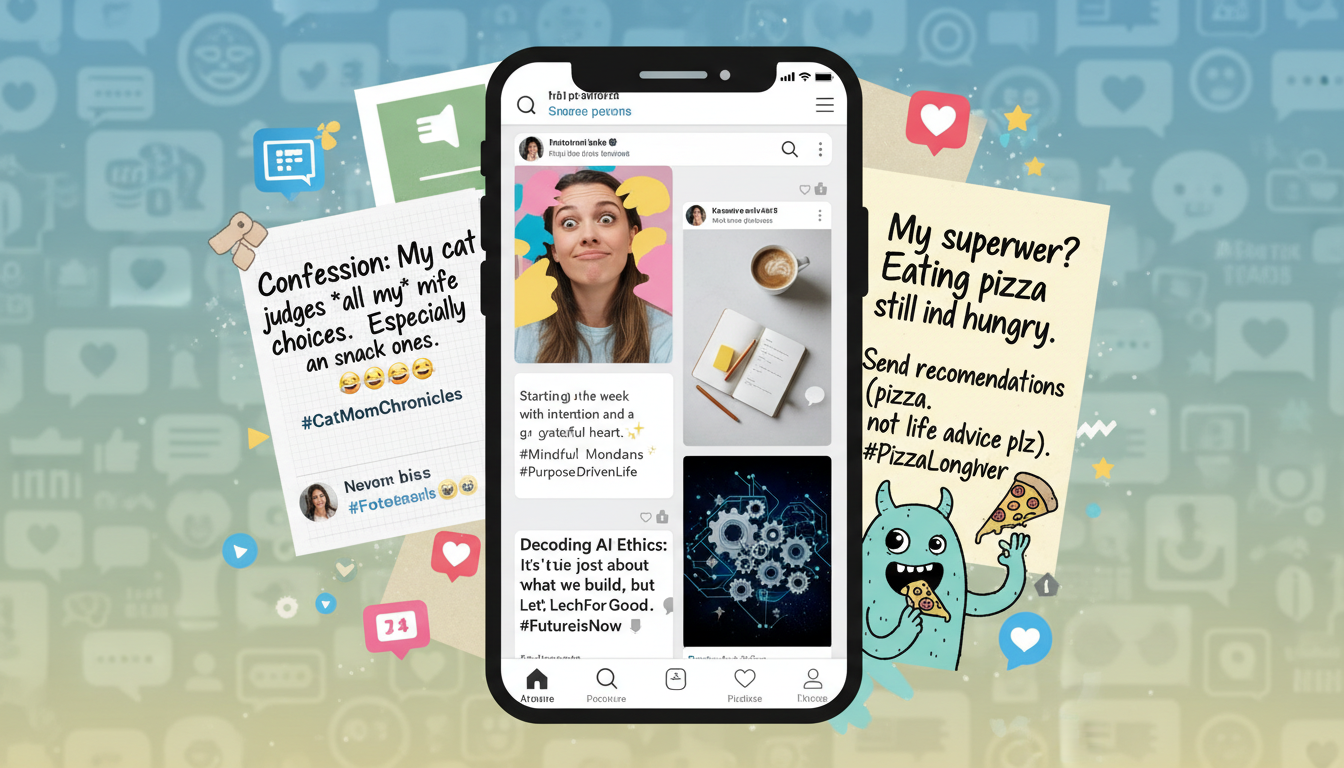 Authentic voice in captions creates genuine connection with followers.
Voice Across Content Types
Different content types allow different tone while maintaining voice.
Motivational Content
Voice expression: Supportive, encouraging, genuine. Share perspective, offer comfort, inspire action.
Example for optimistic voice: "Some days are harder than others, and that's okay. You don't have to have it all figured out. Just keep showing up. That's already enough."
Promotional Content
Voice expression: Enthusiastic but authentic. Genuine excitement, not sales-pitch energy.
Example for casual voice: "Okay so I've been using [product] for a month now and I'm genuinely obsessed. Not being dramatic but it's changed my morning routine completely."
Personal/Vulnerable Content
Voice expression: Authentic, measured vulnerability. Sharing struggles within character parameters.
Example for warm voice: "Been feeling a bit off lately. Sometimes life just feels overwhelming, you know? But I'm working on being gentle with myself. We're all just doing our best."
Educational Content
Voice expression: Helpful, knowledgeable, approachable. Teach without condescension.
Example for supportive voice: "Since so many of you asked, here's how I approach [topic]. These are just things that work for me, find what works for you too."
Fun/Casual Content
Voice expression: Playful, relaxed, fun. Light content that shows personality.
Example for playful voice: "Tell me you're a [trait] without telling me you're a [trait]. I'll go first: [relatable example]."
Story and DM Voice
Voice extends beyond captions.
Story Voice
Stories are more casual but still in character:
Characteristics:
- More spontaneous-feeling
- Slightly more casual than caption voice
- Can use more slang or abbreviations
- Interactive elements match personality
Consistency:
- Greeting style (how character says good morning)
- Sign-off style (how character says goodbye)
- Question asking style
- Reaction style
DM Voice
Direct messages are personal but still in character:
Characteristics:
- Warmer than public content
- More personal attention
- Individual acknowledgment
- Genuine conversation tone
Consistency:
- How character greets DM senders
- Response length and style
- Emoji and punctuation use
- Closing messages
Creating Your Voice Guide
Document voice for consistent reference.
Voice Guide Components
Section 1: Core Identity
- Character name and description
- 3-5 personality traits with explanations
- Overall brand positioning
Section 2: Communication Style
- Formality level
- Length preferences
- Structure tendencies
- Sentence patterns
Section 3: Vocabulary
- Signature words and phrases
- Avoided words and phrases
- Catchphrases
- Emoji usage guidelines
Section 4: Emotional Expression
- Appropriate emotional range
- How character expresses different emotions
- Emotional boundaries
Section 5: Examples
- Sample captions for different content types
- DM response examples
- Story text examples
- Comment response examples
Using Your Voice Guide
Reference before writing:
- Read guide before content creation sessions
- Check content against guide before posting
- Update guide as voice evolves
- Share with anyone helping manage content
Common Voice Mistakes
Avoid these errors that undermine voice consistency.
Mistake 1: Inconsistent Personality
Sometimes bubbly, sometimes serious, sometimes edgy with no pattern.
Fix: Define core traits and express them consistently across all content.
Mistake 2: Generic Voice
Captions that could come from any influencer, no distinctive personality.
Fix: Develop signature elements, specific vocabulary, unique perspective.
Mistake 3: Trying Too Hard
Forced personality that feels inauthentic or exhausting.
Fix: Let voice feel natural within defined parameters. Authentic relaxation within character.
Mistake 4: Voice-Visual Mismatch
Sophisticated visuals with casual "bro" voice, or edgy images with sweet "sunshine" voice.
Fix: Align voice with Apatero visual identity. Both should suggest the same person.
Mistake 5: No Evolution
Same exact voice patterns for years with no development.
Fix: Allow natural evolution while maintaining core identity. Characters grow.
Voice Evolution
Voice can evolve while maintaining identity.
Appropriate Evolution
Natural progression: As following grows, voice might become slightly more polished Character "matures" with audience New interests expand vocabulary Deeper connection allows more vulnerability
Maintaining core: Core personality traits remain Signature elements continue Recognizable identity stays intact
Inappropriate Evolution
Identity breaks: Sudden complete personality change Abandoning signature elements Voice that doesn't match history Unacknowledged transformation
If significant change needed, address it: "I've been growing and changing..." rather than sudden unexplained shift.
Building Your Voice System
Implement voice development systematically.
Week 1: Foundation
Define core elements:
- Personality traits
- Communication style preferences
- Emotional range
- Initial vocabulary choices
Week 2: Documentation
Create voice guide:
- Write comprehensive guide
- Include examples for each section
- Test against past content
- Refine based on analysis
Week 3: Implementation
Apply voice consistently:
- Write all content referencing guide
- Review before posting
- Note challenges
- Adjust guide as needed
Week 4: Refinement
Optimize and expand:
- Add examples that worked
- Remove elements that feel forced
- Develop additional vocabulary
- Strengthen signature elements
Ongoing
Maintain and evolve:
- Regular guide reference
- Periodic guide updates
- Voice consistency audits
- Natural evolution allowance
Voice transforms your AI influencer from a pretty face to a personality followers connect with. The Apatero images create visual identity; voice creates emotional relationship. Invest in developing authentic, consistent communication, and watch follower connection deepen.
FAQ
How do I develop voice for a character different from myself?
Document the character's personality thoroughly. Reference the guide constantly. Read captions aloud and ask "would this person say this?" Practice until it becomes natural.
Can my AI influencer's voice change over time?
Yes, authentic evolution is natural. Characters grow and develop. Make changes gradual and maintain core identity.
How casual or formal should the voice be?
Match your target audience expectations and character positioning. Younger audiences expect more casual; professional niches expect more polish.
What if my voice isn't resonating with audiences?
Test adjustments. Try different approaches while maintaining core personality. Analyze what content gets best engagement and adapt.
Should I use slang and trending phrases?
If it fits your character authentically. Forced trend adoption feels inauthentic. Natural use of appropriate slang works well.
How do I maintain voice when I'm tired or rushed?
Reference your voice guide. Have sample captions to model. Never post without checking against guide when consistency feels challenging.
Reuse a character reference
Save a character as a Soul and put them in any scene, image or video, without retraining anything. Check your welcome allowance and the displayed cost before generating.
Related Articles

5 Proven AI Influencer Niches That Actually Make Money in 2025
Discover the most profitable niches for AI influencers in 2025. Real data on monetization potential, audience engagement, and growth strategies for virtual content creators.

AI Background Replacement: Professional Guide 2025
Master AI background replacement for professional results. Learn rembg, BiRefNet, and ComfyUI workflows for smooth background removal and replacement.
AI Character Consistency: How to Maintain Virtual Persona Identity Across Content
Learn techniques for maintaining AI character consistency across hundreds of images. Master the art of creating recognizable virtual personas with consistent visual identity.